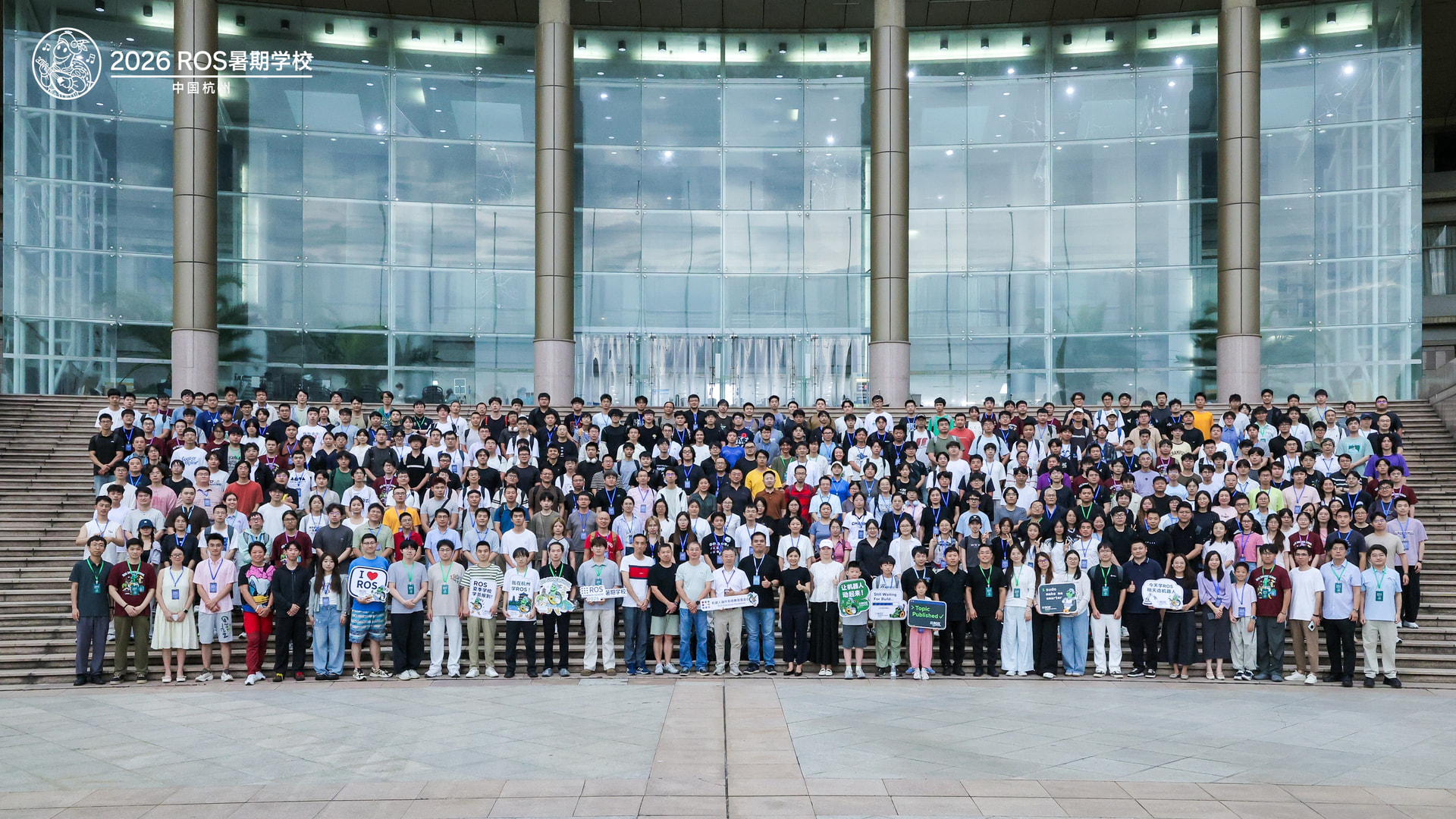
<p>The <a href='https://discourse.openrobotics.org/t/2026-ros-summer-school-hangzhou-china-successfully-concludes/56913'>Hangzhou ROS Summer School report</a> is useful less as a product announcement than as a snapshot of what open robotics training currently treats as essential. Its organisers describe seven days of lectures, laboratory work and project reviews covering ROS 2 foundations, perception, navigation, manipulation, simulation, industrial interfaces and multi-robot systems. The report also makes clear what it does not provide: independent benchmarks, reproducible test logs or evidence that a classroom project is ready for production.</p><h2>A curriculum built around interfaces</h2><p>The published curriculum spans the main software boundaries that make a robot system portable. It includes ROS 2 development, TF2 coordinate transforms, sensor processing, SLAM and autonomous navigation, MoveIt 2 motion planning, simulation, vision, multi-robot collaboration and robot software engineering. Industrial ROS-I standards are also listed as a dedicated topic. That combination matters because a robot rarely fails at only one layer. A navigation result depends on sensors, transforms, timing, planners, hardware drivers and the way operators observe failures.</p><p>The report says the programme used parallel specialist tracks rather than one linear course. It also describes practical work on mobile robots, collaborative arms and LiDAR kits. This is a meaningful choice for open robotics: participants were expected to connect software concepts to physical systems instead of treating ROS as an isolated programming framework. However, the announcement does not identify the exact robot models, sensors, ROS distributions, middleware configurations or simulation versions used in each track.</p><h2>What the organisers count as an outcome</h2><p>According to the organisers, the event brought together more than 700 students, researchers and industrial practitioners from more than 300 institutions. The report says instructors from Open Robotics, the ROS-I Consortium and robotics laboratories combined theoretical teaching with hands-on debugging. Participants reportedly completed standardised laboratory assignments and small robot-development tasks on dedicated hardware.</p><p>The final project demonstrations covered indoor autonomous navigation, vision-based grasping, cooperative transport by multiple robots, lightweight industrial deployment, and systems involving vision-language-action or large language models. These topics reflect current research priorities, but the report presents them as project themes rather than measured results. It does not publish navigation success rates, grasp repeatability, transport throughput, latency, energy use, failure counts or comparisons against a baseline.</p><h2>The open-source claim is practical, but still incomplete</h2><p>The strongest open-robotics element is the reported resource package. The organisers say attendees received lecture slides, laboratory source code, simulation files and recorded tutorials for continued study. That could make the programme more useful beyond the classroom, especially if the materials include version-pinned dependencies and the same datasets or robot descriptions used during the exercises.</p><p>There is also a detail that deserves attention. The announcement describes 23 parallel training tracks, but later says the distributed digital package covers 20 tracks. It does not explain the difference. Nor does the page provide repository links, commit identifiers, release versions or instructions for reproducing the demonstrations. Until those details are published, the resource claim should be read as a reported deliverable, not as independently verified open research infrastructure.</p><h2>What the report does not demonstrate</h2><p>A course report is not a benchmark paper and it is not a safety case. The announcement contains no test protocol for the robots, no description of emergency-stop procedures, no risk assessment for shared workspaces and no account of incidents or near misses. It also does not state how many project attempts failed, how much operator intervention was required or whether demonstrations were repeated under changed lighting, layouts, payloads or network conditions.</p><p>That limitation is important when the report mentions real-world mini robot development tasks. A physical demonstration can show that a system worked under the organisers' chosen conditions. It cannot, on its own, establish robustness across hardware variants or prove that an autonomous behaviour is safe outside the training environment. The same caution applies to the references to VLA and LLM-based systems: the announcement identifies them as project areas, but gives no evidence about generalisation, hallucinated commands, recovery behaviour or human oversight.</p><h2>How to use this announcement</h2><p>For researchers and developers, the report is best used as a map of the open stack rather than a performance verdict. It shows which interfaces are being taught together: coordinate frames, sensor pipelines, planning, simulation, industrial integration and fleet-level cooperation. Those boundaries are a sensible checklist when evaluating a new ROS project or training resource.</p><p>Before treating any result as transferable, readers should ask for the ROS distribution and package versions, hardware bill of materials, calibration procedure, test environments, recorded datasets, success criteria, failure handling and independent reruns. For safety-sensitive work, they should also ask how people were kept outside robot workspaces, how motion was stopped and what happened when perception or communications degraded. These are not criticisms of the summer school; they are the evidence needed to move from an educational demonstration to a defensible engineering claim.</p><p>The Hangzhou report therefore offers a useful, recent view of open robotics practice: broad, hardware-connected and increasingly attentive to industrial standards. Its value is in showing the stack and the learning tasks that organisers chose to expose. Its limits are equally clear. Without public artefacts and measured outcomes, it should inform research planning and curriculum design, not be cited as proof of production readiness or comparative robot capability.</p><section class="media-fleet-sources"><h2>Official sources</h2><ul><li><a href="https://discourse.openrobotics.org/t/2026-ros-summer-school-hangzhou-china-successfully-concludes/56913">Official source: discourse.openrobotics.org</a></li></ul></section><aside class="media-fleet-related"><h2>Related reading</h2><ul><li><a href="https://rentbuyrobot.com/article/agility-digit-toyota-canada-pilot-commercial-deployment">Agility Digit Toyota Canada Pilot Commercial Deployment</a></li><li><a href="https://rentbuyrobot.com/article/nvidia-sim-to-real-field-robot-validation">Nvidia Sim To Real Field Robot Validation</a></li></ul></aside>
PrototypeReport
ROS Summer School 2026: What the Open Stack Actually Tested
An evidence-led reading of the Hangzhou report maps the open ROS tools and practical exercises while separating training claims from measured robot performance.