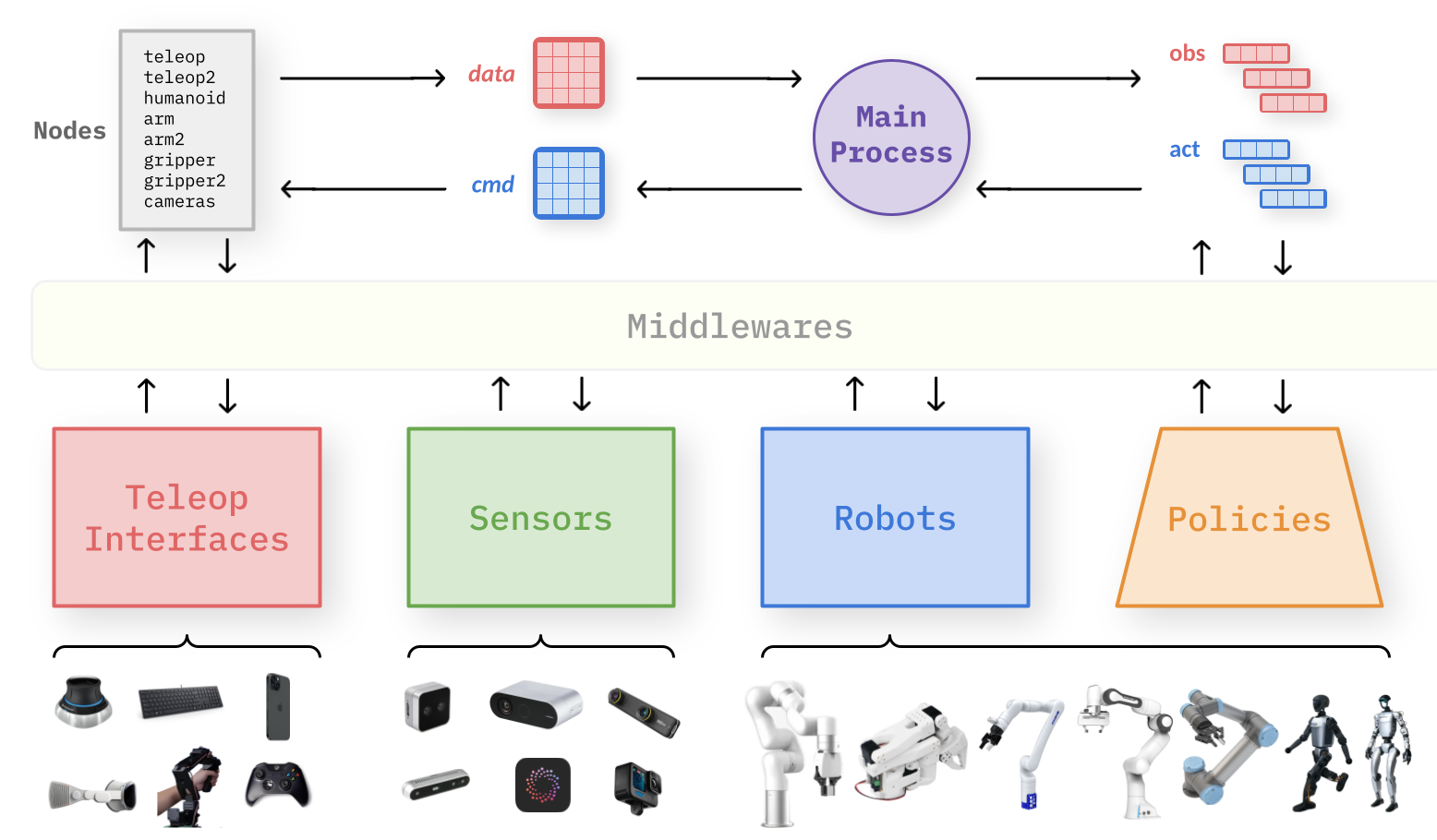
<p>Robotics research often loses time before an experiment begins. A new arm, humanoid or sensor arrangement can require weeks of platform-specific integration, leaving researchers to rebuild control, data-collection and teleoperation software instead of testing a new behaviour. Carnegie Mellon University’s Robotics Institute has announced RIO, an open-source framework intended to reduce that repeated setup work.</p><p>The <a href='https://www.ri.cmu.edu/robot-io/'>official CMU announcement</a> describes RIO as a unified interface for robot control, data collection, teleoperation and AI deployment. Its purpose is practical: let a research team reuse software components while moving between different robots and configurations. That makes RIO relevant to open robotics research because the main promise is interoperability and reproducibility, not a new robot body or a consumer-facing product launch.</p><h2>What RIO is designed to do</h2><p>RIO is built around modular components that can be combined and adapted for different research projects. In the announcement, CMU says the framework is intended to work across robotic arms, humanoids and other platforms. The same general pipeline can therefore be used for tasks such as operating a robot remotely, recording demonstrations, passing sensor data to a policy and deploying an AI-controlled behaviour.</p><p>This separation between hardware-specific drivers and reusable research logic addresses a familiar problem. A policy developed on one robot may depend on a particular camera layout, communication method, actuator interface or data format. When the hardware changes, researchers often have to rewrite large parts of the stack before they can determine whether the policy itself transfers. A modular interface does not solve the embodiment gap, but it can make that gap easier to measure because fewer unrelated software changes are introduced at the same time.</p><p>CMU also reports an internal setup exercise in which a participant with machine-learning experience but no robotics background configured a robotic arm for teleoperation in about two hours, starting from unpacking the hardware. That is a useful indication of the project’s accessibility goal. It is not, however, a general deployment benchmark. The result concerns one documented setup exercise, not every supported robot, sensor combination or production environment.</p><h2>Why shared infrastructure matters for research</h2><p>Open robotics projects are often judged by their algorithms, datasets or demonstrations. The less visible infrastructure underneath them can be just as important. If every laboratory collects data through a different interface, uses incompatible representations and maintains its own control glue, reproducing a result becomes expensive. Researchers may struggle to tell whether a difference comes from the learning method, the hardware, the sensors or the software pipeline.</p><p>RIO’s stated contribution is to provide common building blocks for those layers. In principle, that can help teams compare policies on more than one embodiment, repeat experiments with less custom integration and share software without requiring every user to adopt the same robot. It can also lower the entry barrier for students and smaller laboratories that cannot afford a large platform-engineering team.</p><p>The practical value will depend on how broad and stable the hardware support becomes. A framework can be architecturally flexible while still requiring substantial work for a new actuator, camera, middleware or safety controller. The CMU announcement explicitly presents RIO as an active research project and lists expanded hardware support as future work. That qualification matters: the announcement supports a research infrastructure claim, not a conclusion that cross-platform deployment has become routine.</p><h2>Limits that should remain visible</h2><p>RIO should not be read as a safety certification or as a substitute for a robot manufacturer’s controller, risk assessment or protective system. A shared interface may simplify communication and data flow, but it does not automatically guarantee collision avoidance, force limits, emergency-stop behaviour, cybersecurity or compliance with the requirements of a particular laboratory or workplace. Those controls remain hardware-, software- and context-dependent.</p><p>The same caution applies to AI deployment. Moving a policy between platforms can expose differences in reach, balance, calibration, latency, contact dynamics and failure recovery. A policy that runs through a common interface has not necessarily demonstrated equivalent performance or safety on each robot. Each transfer still needs controlled validation, supervision and a clear fallback state.</p><p>For researchers, the sensible use of RIO is therefore methodological. First, document the robot, sensors, middleware, policy and data format used in an experiment. Then record which components are unchanged when the experiment moves to another platform. Finally, measure task success, intervention rate, latency and failure modes separately for each embodiment. This keeps the framework’s interoperability promise testable instead of turning it into a vague claim of general-purpose intelligence.</p><h2>A useful direction, with evidence still bounded</h2><p>CMU’s announcement identifies a real bottleneck: researchers need dependable infrastructure to collect the data and run the experiments that modern robot-learning systems require. RIO’s open-source, modular approach is aimed at that bottleneck and could make cross-platform research easier to organise and reproduce.</p><p>The evidence currently supports a narrower conclusion than the broader language sometimes used around robot foundation models. RIO is a research framework with a documented setup example, a stated cross-embodiment objective and an active development roadmap. It is not proof that a single AI policy can safely operate every robot, nor is it a turnkey production platform. That distinction is precisely why the project is worth watching: better shared infrastructure can make future claims about robot learning easier to reproduce, compare and challenge.</p><section class="media-fleet-sources"><h2>Official sources</h2><ul><li><a href="https://www.ri.cmu.edu/robot-io/">Official source: ri.cmu.edu</a></li></ul></section><aside class="media-fleet-related"><h2>Related reading</h2><ul><li><a href="https://rentbuyrobot.com/article/agility-digit-live-warehouse-work-safety-limits">Agility Digit Live Warehouse Work Safety Limits</a></li><li><a href="https://rentbuyrobot.com/article/nvidia-isaac-stack-field-robot-developer-verification">Nvidia Isaac Stack Field Robot Developer Verification</a></li></ul></aside>
PrototypeReport
CMU’s RIO Targets the Infrastructure Gap in Open Robot Research
Carnegie Mellon’s open-source RIO framework is designed to move control, teleoperation, data collection and AI deployment across robot platforms. Here is what the announcement supports—and what it does not.