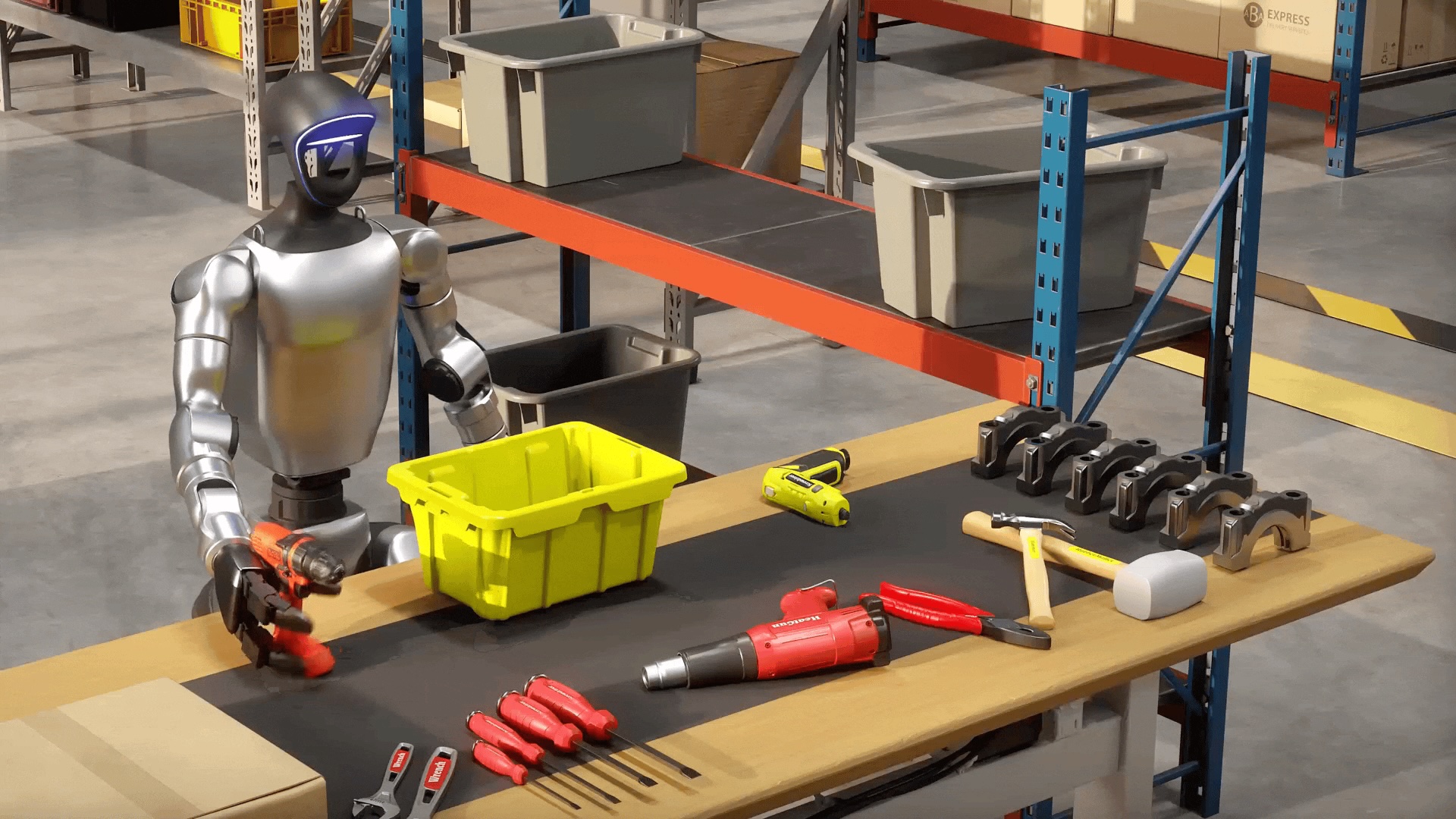
<p>NVIDIA’s March 18, 2026 robotics update is less about a new robot than about the software path between a robot idea and a machine that has to operate outside the lab. The company says its Isaac platform now brings together models, data pipelines, simulation, runtime libraries and edge deployment in an open, composable workflow. For teams working on autonomous mobile robots, inspection machines or other field systems, that is the useful news. It is also a claim that needs to be read as a development roadmap, not as proof that any particular robot is ready for unsupervised work.</p><p>The announcement connects <a href="https://blogs.nvidia.com/blog/build-robots-with-ai/">NVIDIA Isaac</a> with Isaac Sim, Isaac Lab, the GR00T N vision-language-action model family, teleoperation data and Jetson-based inference. NVIDIA describes a three-computer pattern: compute for training, simulation and the robot’s onboard runtime. That separation matters in the field. A team can train and evaluate away from the vehicle, then move a selected policy to edge hardware without assuming a permanent cloud connection. It does not, however, guarantee that a sensor driver, motor controller, safety PLC or communications link will work simply because the model runs on Jetson.</p><h2>What developers can actually reuse</h2><p>The most concrete compatibility promise is at the workflow level. NVIDIA says Isaac Sim and Isaac Lab can use multiple physics backends, including Newton, PhysX and MuJoCo, and that Isaac Lab 3.0 can run many lightweight environments in parallel. Its Isaac Lab-Arena tooling is presented as a way to compose tasks and evaluate policies against benchmarks. For a field-robot team, the practical benefit is repeatability: the same terrain, obstacle layout, payload and task definition can be replayed while a perception or navigation policy changes.</p><p>The update also describes Omniverse NuRec turning sensor data into OpenUSD-based interactive simulations, and Isaac Teleop capturing demonstrations through extended-reality headsets, body trackers or gloves. That creates a plausible route for difficult work such as inspection, rough-terrain navigation or manipulation in places where collecting every failure physically would be slow or dangerous. The important qualification is “plausible”: the announcement does not publish a field-robot success rate, a sensor-by-sensor compatibility matrix or a repeatable weather and terrain benchmark.</p><p>There is a second portability layer. NVIDIA says Isaac runtime libraries can accelerate perception and mobility on the edge, while cuVSLAM can support visual localization and mapping on embedded Jetson hardware. SOMA-X is described as a shared representation for skeletons, motion and identity, intended to reduce rework when a body model or robot platform changes. Those abstractions can reduce integration effort, but they do not remove the need to validate camera timing, lens distortion, inertial calibration, wheel slip, actuator limits and the robot’s actual compute budget.</p><h2>Where the field use begins—and stops</h2><p>NVIDIA’s own examples span autonomous mobile robots, humanoids, robot arms and terrain such as snow or gravel. The post also points to FieldAI workflows and to simulation of forklifts on inclines. This makes the platform relevant to inspection, logistics around outdoor sites, agriculture-adjacent mobility and research vehicles. Yet the announcement is about tools and infrastructure. It is not evidence that a specific robot has completed a regulated inspection route, operated safely near the public or maintained autonomy through dust, rain, glare, intermittent positioning or degraded communications.</p><p>A sensible developer sequence is therefore straightforward. First, define the robot, sensors, operating envelope and stop conditions before collecting data. Second, build the environment and task in simulation, including nominal and rare hazards. Third, compare software-in-the-loop with hardware-in-the-loop so that latency, memory, thermal behavior and the selected edge computer are measured rather than assumed. Fourth, replay logged and teleoperated data, then test the policy against changes in lighting, terrain, object placement and network availability. Finally, run a supervised site trial with a physical emergency stop, a conservative speed envelope and a human who can take control.</p><h2>Safety and regulation remain separate work</h2><p>The announcement mentions safe deployment and lists <a href="https://blogs.nvidia.com/blog/build-robots-with-ai/">NVIDIA Halos</a> among the stack’s safety resources, but a development framework is not a completed safety case. Simulation can expose collisions, localization loss and policy regressions; it cannot by itself establish that a machine meets the machinery, workplace or functional-safety obligations that apply at a real site. The integrator still has to identify hazards, define protective measures, document residual risk and verify the complete robot system, including tools, payloads, remote controls and fallback behavior.</p><p>The same boundary matters even more for drones. Putting Isaac or Jetson on an aerial platform does not create permission to fly, satisfy remote-identification or registration duties, or authorize operations over people, beyond visual line of sight or in restricted airspace. Those decisions belong to the operator and the applicable aviation authority. For ground field robots, land access, privacy, radio use, site rules and worker protection can be just as decisive as model accuracy. NVIDIA’s announcement makes no claim of regulatory approval for a deployment.</p><p>The takeaway is useful but narrow: NVIDIA is making the development chain more modular, testable and portable across simulation, teleoperation and edge hardware. That can help a field-robot team spend less time rebuilding tooling and more time measuring behavior. It cannot substitute for device-level integration, representative environmental testing, a documented safety assessment or the permissions required for the mission. Treat Isaac as an engineering platform, then demand evidence at the robot and site level before calling the system ready.</p><section class="media-fleet-sources"><h2>Official sources</h2><ul><li><a href="https://blogs.nvidia.com/blog/build-robots-with-ai/">Official source: blogs.nvidia.com</a></li></ul></section><aside class="media-fleet-related"><h2>Related reading</h2><ul><li><a href="https://rentbuyrobot.com/article/ros-summer-school-2026-open-robotics-stack">Ros Summer School 2026 Open Robotics Stack</a></li><li><a href="https://rentbuyrobot.com/article/agility-digit-toyota-canada-pilot-commercial-deployment">Agility Digit Toyota Canada Pilot Commercial Deployment</a></li></ul></aside>
PrototypeReport
NVIDIA’s Isaac stack: what field-robot developers can verify
NVIDIA’s March 2026 robotics update links Isaac simulation, teleoperation and Jetson deployment. Here is what field developers can verify before deployment—and what it does not prove.