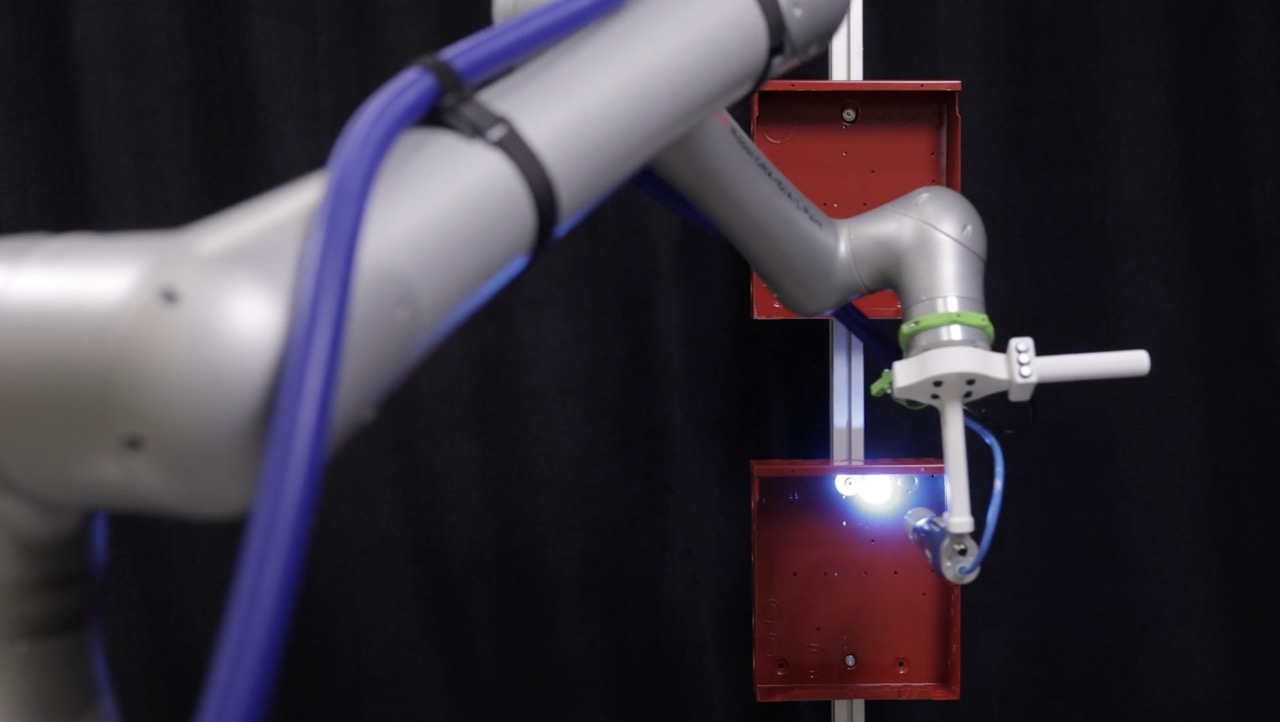
<p>Hirebotics announced on June 25, 2026 a Cobot Painter built around FANUC's CRX-10iA/L Paint hardware and the Beacon no-code platform. The company says the system is available now and is intended for high-mix, low-volume metal fabrication, where traditional automated paint lines can be too expensive or inflexible. The practical question is not whether the arm can repeat a taught path. It is where the announced deployment shortcut stops, and which production and safety checks remain the responsibility of the integrator and plant.</p><h2>What the announcement actually covers</h2><p>According to Hirebotics' <a href='https://www.hirebotics.com/newsroom/hirebotics-launches-industrys-first-no-code-explosion-proof-cobot-solution-for-painting/'>official announcement</a>, the Cobot Painter combines a FANUC CRX-10iA/L Paint collaborative robot with Beacon software. Operators can use a tablet or phone to teach a spray path by guiding the robot through the motion once, then set the same speed, distance and angle for repeat cycles. The company describes the arm as explosion-proof and says it is approved for liquid painting, powder coating and gel coating applications in hazardous environments.</p><p>The hardware is specified in the announcement with a 55.82-inch reach. Hirebotics positions the system as portable: parts are placed in a paint booth, the robot performs the spraying operation, and the unit can be moved when the workflow changes. That is materially different from an automated line with permanent conveyor integration, dedicated cell construction and fixed process tooling.</p><h2>The deployment claim is narrower than the headline</h2><p>The most important limitation is stated near the end of the release: the current Cobot Painter supports stationary painting only. The workpiece must be placed in the booth before spraying. Line tracking, in which the robot follows and paints parts moving continuously along a production line, is described as a future version rather than a current capability.</p><p>That boundary matters for buyers. A portable robot can reduce fixed infrastructure, but it does not remove the need for stable fixturing, repeatable part presentation, surface preparation, spray-gun setup, masking and post-process inspection. A 55.82-inch reach may be useful for large fabrications, yet reach alone does not establish coverage of complex geometry, access to recessed surfaces or acceptable finish quality across different coatings. The announcement does not publish cycle-time data, throughput targets, transfer-efficiency measurements, coating-thickness results or independent defect rates.</p><p>Hirebotics also says the system can be deployed in days rather than months. That is a vendor deployment claim, not a measured result presented for a named customer or a defined production cell. The time required in practice will depend on the existing booth, paint equipment, workholding, operator training, network setup and local compliance checks.</p><h2>Safety is still a property of the complete cell</h2><p>An explosion-proof robot can address an important equipment-classification problem, but the label should not be read as permission to place any robot in any spray area. The safety case includes the booth, ventilation, paint chemistry, hoses, spray equipment, grounding, emergency stops, access control and maintenance procedures. It also has to account for the robot's end effector and the workpiece, not only the arm.</p><p>The collaborative designation should be treated with the same care. Collaboration functions can reduce some contact risks, but they do not eliminate hazards from atomized coatings, pressurized spray equipment, moving fixtures, unexpected restarts or manual loading. Before deployment, a plant should document the intended operating zone, verify the applicable hazardous-environment classification, test stop and restart behavior, and define who may teach paths or change process parameters. Those checks are not supplied by a phone-based interface.</p><h2>What a professional deployment should measure</h2><p>The announcement gives manufacturers a plausible use case, but a production decision should be based on local evidence. A short acceptance trial can compare the robot with the existing manual process using the same parts and coating batches.</p><ul><li>Measure time from setup to the first qualified part, not only the time to teach a path.</li><li>Record cycle time, changeover time and operator interventions across several part geometries.</li><li>Measure coating thickness, coverage, overspray, material consumption and rework separately.</li><li>Log stops, emergency-stop activations, interlock events and recovery time during representative shifts.</li><li>Check whether the proposed reach and fixturing maintain access without forcing operators into the spray zone.</li></ul><p>These measurements would show whether the claimed flexibility improves the actual bottleneck. They would also expose limits that a demonstration can hide, such as difficult corners, changing part tolerances, paint viscosity changes or cleaning requirements between jobs.</p><h2>What is confirmed, and what remains unproven</h2><p>The confirmed scope is a current stationary painting system built on FANUC's CRX-10iA/L Paint and controlled through Hirebotics' Beacon interface. The product page provides additional vendor detail on the intended workflows, but it does not turn the launch announcement into an independent performance test. There is no named customer result in the release that establishes output, finish quality or uptime in routine production.</p><p>For manufacturers, that makes the announcement relevant as a deployment option rather than a ready-made safety or return-on-investment conclusion. The system may be a sensible fit where a shop already has a suitable booth, repetitive parts and a need to automate small batches without building a permanent line. It is not evidence that every manual spray operation can be transferred in days, nor that future line tracking is available today.</p><p>The useful takeaway is therefore specific: Hirebotics has announced a portable, no-code, stationary paint-cobot configuration aimed at existing spray environments. Its value should be judged through documented finish quality, material use, changeovers and cell-level risk controls before any broader production claim is accepted.</p><section class="media-fleet-sources"><h2>Official sources</h2><ul><li><a href="https://www.hirebotics.com/newsroom/hirebotics-launches-industrys-first-no-code-explosion-proof-cobot-solution-for-painting/">Official source: hirebotics.com</a></li><li><a href="https://www.hirebotics.com/solutions/cobot-painter/">Official source: hirebotics.com</a></li></ul></section><aside class="media-fleet-related"><h2>Related reading</h2><ul><li><a href="https://rentbuyrobot.com/article/nvidia-toyota-simulation-first-robot-deployment">Nvidia Toyota Simulation First Robot Deployment</a></li><li><a href="https://rentbuyrobot.com/article/nasa-astrobee-arkisys-open-space-robotics-research">Nasa Astrobee Arkisys Open Space Robotics Research</a></li></ul></aside>
PrototypeReport
Hirebotics Paint Cobot: Deployment Scope and Safety Limits
Hirebotics pairs a FANUC paint cobot with no-code Beacon software. The announcement is useful, but its deployment claim remains narrower than a complete production safety case.