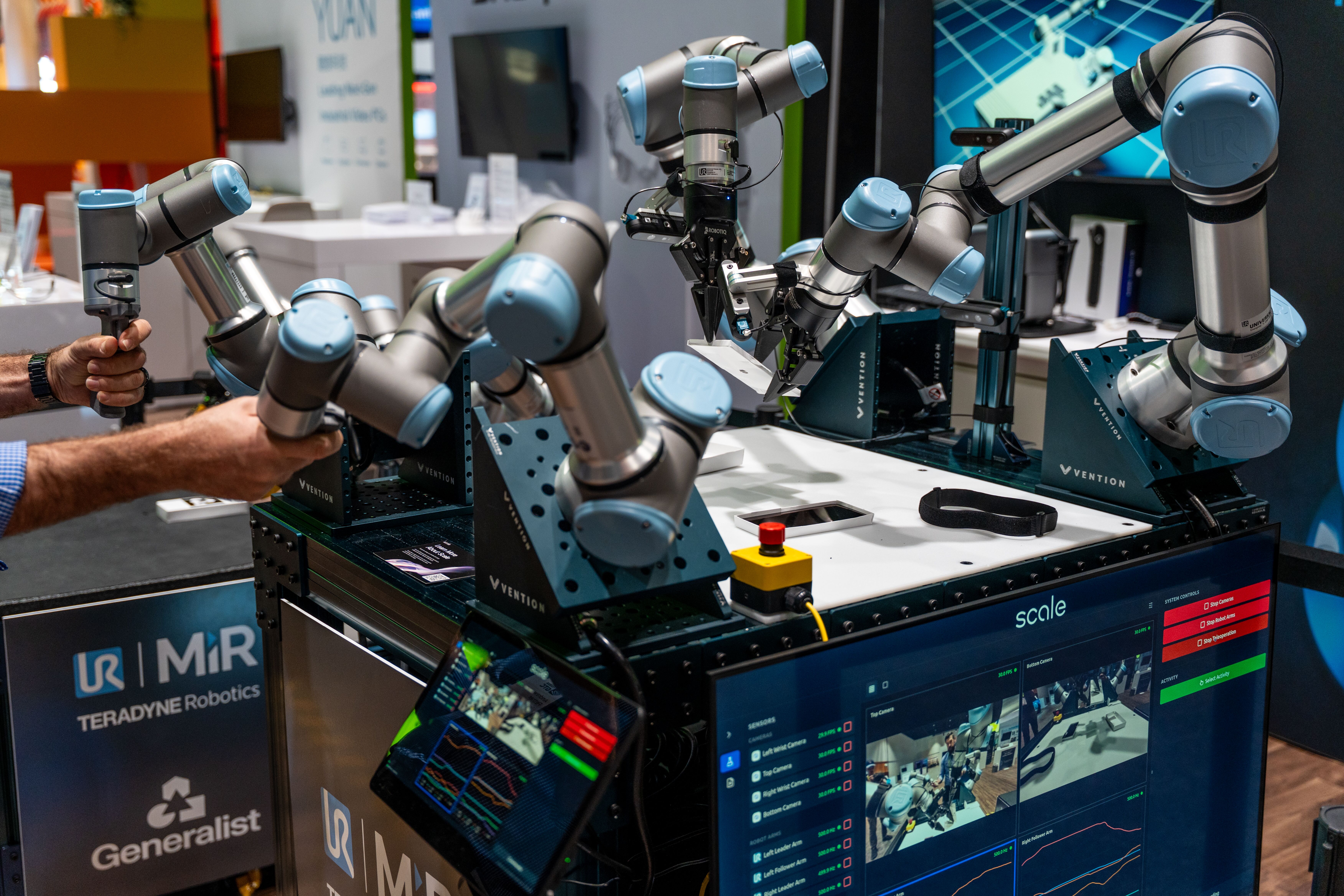
<p>Universal Robots’ <a href='https://www.universal-robots.com/blog/physical-ai-five-questions-from-the-factory-floor/'>official factory-floor Q&A</a>, published on March 25, 2026, offers a useful reality check for manufacturers assessing physical AI. The publication is not a product launch or a claim of autonomous factory operation. Instead, it addresses five questions about deployment safety, validation, performance, compatibility and current limitations.</p><p>That distinction matters for industrial cobot projects. Physical AI can make a robot more adaptable, but it does not remove the engineering work required to define a safe application. Universal Robots’ vice president of AI Robotics Products says the fundamentals remain familiar: every deployment still requires a proper risk assessment, even when an AI model is making decisions about perception or motion.</p><h2>Safety has to remain outside the AI application</h2><p>Universal Robots describes a safety envelope that operates independently of the application layer. According to the company, manufacturers can define maximum tolerable speeds, configure virtual safety fencing and constrain robot behaviour at the safety-system level. The practical implication is that an AI system should be allowed to vary only inside a pre-defined operating envelope.</p><p>This is an important boundary for shared workspaces. A cobot’s collaborative design does not make every application automatically safe. Tooling, grippers, workpieces, sharp edges, pinch points, impact energy and the position of people around the cell still influence the risk profile. The <a href='https://www.universal-robots.com/products/polyscope-5/'>PolyScope 5 documentation</a> lists 17 certified safety features for e-Series systems, including tools for limiting joint motion and defining safety planes. Those functions support risk reduction, but they do not replace application-specific validation by the manufacturer, integrator and site safety team.</p><h2>Validation is still the difficult part</h2><p>The Q&A is particularly direct about regulated manufacturing. In pharmaceutical environments operating under GMP requirements, a robot must deliver a repeatable process outcome, not merely an impressive demonstration. Universal Robots says manufacturers are beginning to explore statistical validation of physical AI models, but there is no ready-made method that removes the need to understand the process, the model and the operating conditions.</p><p>For deployment teams, that means defining the task narrowly enough to measure it. A useful validation record should identify the parts and variants presented to the robot, the allowed grasp and placement outcomes, the acceptable error rate, recovery behaviour and the conditions under which the system must stop or request human intervention. A model that succeeds on a clean demonstration does not automatically have a validated operating envelope for production.</p><h2>Fast robot control can contain slower AI decisions</h2><p>Universal Robots also separates AI reasoning from the robot controller’s real-time motion layer. The company says many AI models operate at roughly 10 to 30 hertz, while industrial robot controllers run at much higher deterministic rates. When AI outputs are integrated into the robot’s real-time control layers, slower decisions can be interpolated into more reactive motion, reaching down to 500 hertz in the architecture described by the company.</p><p>That figure should not be read as a universal application performance guarantee. It describes a control architecture, not a promised cycle time, latency limit or throughput result for every model and cell. The more useful takeaway is architectural: a narrowly defined perception or tactile-control model can provide a decision while deterministic robot control continues to enforce the motion constraints. Fully end-to-end systems remain harder to validate over long production periods.</p><h2>Existing cobots can be part of the evaluation</h2><p>Universal Robots says physical AI can be used with existing e-Series robots running PolyScope 5 when the AI workload is handled externally and real-time control remains on the robot. That does not make the integration plug-and-play. The plant still needs suitable computing hardware, communications, software integration, monitoring and a way to fail safely if the external model becomes unavailable or produces an unusable output.</p><p>The company positions PolyScope X and the newer <a href='https://www.universal-robots.com/products/ur-series/'>UR Series</a> as a more integrated foundation for physical AI. The product family includes models ranging from the UR8 Long at 10 kg payload and 1,750 mm reach to the UR30 at 35 kg payload and 1,300 mm reach. These figures describe robot capability, not proof that an AI-enabled application can safely use the full payload or workspace in collaborative operation. End-effector mass, speed, reach, process forces and the surrounding cell must still be assessed together.</p><h2>Where the limits remain visible</h2><p>Universal Robots identifies tasks involving difficult physics as the hardest area for physical AI. Extreme accuracy, repeatability and high variation remain active development challenges. The company also notes that visual inspection and computer-vision applications are progressing faster than tasks that require delicate contact, complex manipulation or consistent performance across many physical conditions.</p><p>For manufacturers, the sensible deployment question is therefore not whether a cobot is intelligent enough in the abstract. It is whether the task can be bounded and measured. Teams should begin with a defined part family, a limited set of failure modes and a clear human fallback. They can then compare success rate, recovery time, intervention frequency and process repeatability against the existing manual or programmed baseline.</p><p>Universal Robots’ publication is valuable precisely because it keeps those limits in view. Physical AI may broaden the range of tasks that industrial cobots can attempt, but safe deployment still depends on independent safety controls, evidence of repeatable performance and a task scope that can be audited. For production engineering teams, that is a more credible starting point than treating a flexible robot demonstration as proof of factory readiness.</p><section class="media-fleet-sources"><h2>Official sources</h2><ul><li><a href="https://www.universal-robots.com/blog/physical-ai-five-questions-from-the-factory-floor/">Official source: universal-robots.com</a></li><li><a href="https://www.universal-robots.com/products/polyscope-5/">Official source: universal-robots.com</a></li><li><a href="https://www.universal-robots.com/products/ur-series/">Official source: universal-robots.com</a></li></ul></section><aside class="media-fleet-related"><h2>Related reading</h2><ul><li><a href="https://rentbuyrobot.com/article/universal-robots-physical-ai-industrial-cobot-deployments-automate-2026">Universal Robots Physical Ai Industrial Cobot Deployments Automate 2026</a></li></ul></aside>
PrototypeReport
Universal Robots’ factory-floor Q&A puts physical AI safety and limits first
Universal Robots’ latest factory-focused Q&A outlines where physical AI can assist industrial cobots today—and where risk assessment, validation and tightly scoped tasks remain essential.