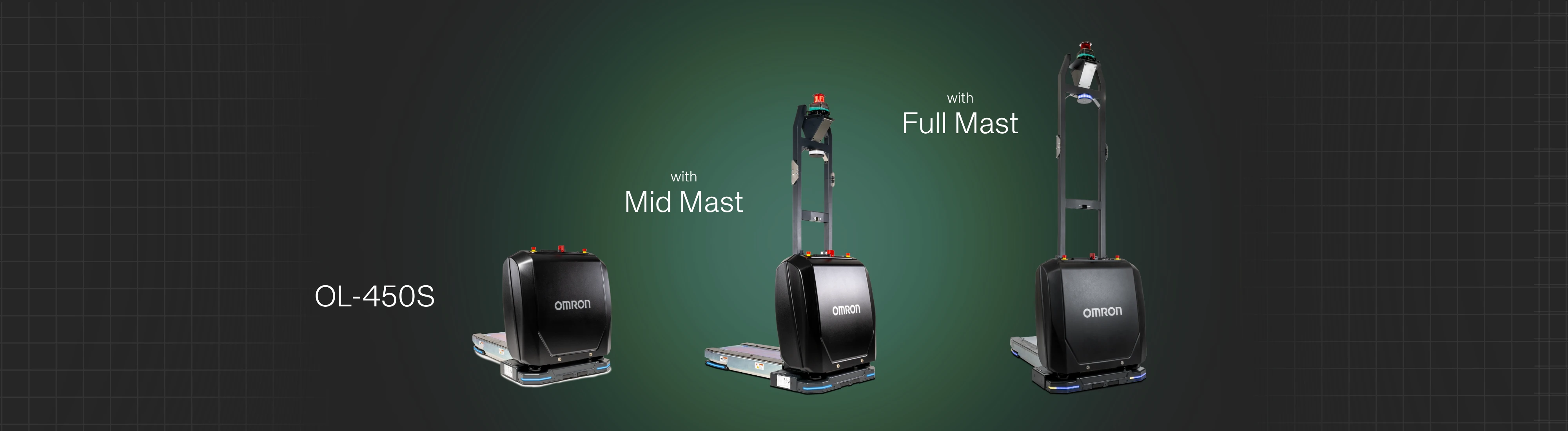
<p>OMRON Robotics has expanded the configuration range of its OL-450S autonomous mobile robot (AMR), a platform designed to move carts and load carriers through production and intralogistics areas. The company’s announcement adds a no-mast version plus optional 1.2-metre and 1.6-metre mast configurations. The practical question for manufacturers is not simply which version looks more capable, but which scanning height fits the actual ceiling, traffic pattern and recovery procedures of a working facility.</p><h2>What the announcement changes</h2><p>The new options change the position of the robot’s scanning equipment, not the basic transport mission. The no-mast configuration keeps the vehicle at its lowest profile for narrow aisles, low doorways, overhead structures and areas around fixed machinery. The mid-mast version raises the scanner to improve visibility and localisation in busier shared spaces. The full-mast version places the scanner higher again for larger or more navigation-complex environments where overhead clearance is not a limiting factor.</p><p>That distinction matters during procurement. A mast is a deployment choice tied to the building and workflow. It is not evidence that the robot can automatically handle every layout, nor does the announcement claim a new payload class or a measured productivity gain from changing mast height.</p><h2>Where each configuration fits</h2><p>For a low-clearance production route, the no-mast model has an obvious advantage: it preserves access beneath structures that could block a taller robot. That can include low doors, lifts, conveyors and storage interfaces. The trade-off is that a floor-level scanner may have a less favourable view of people, carts and equipment in a dense, changing environment. Integrators therefore need to check whether the robot can maintain reliable localisation and obstacle detection along the complete route, not only in an open demonstration area.</p><p>The 1.2-metre mid-mast configuration is aimed at a compromise. OMRON says the elevated scanning position can improve visibility in dynamic, high-traffic spaces while retaining access through many doorways, elevators and lower-clearance areas. That makes it a candidate for facilities where operators, carts and mobile equipment share aisles, but where a full-height mast would create too many access restrictions.</p><p>The 1.6-metre configuration is intended for environments where higher reference points improve navigation robustness and available headroom is sufficient. It may be useful in large production or warehouse spaces, but every overhead constraint becomes part of the acceptance test. Door tracks, sprinklers, lighting, rack beams and lift entrances need to be checked with the robot and its load, not just against a drawing of the bare vehicle.</p><h2>Capacity remains measurable</h2><p>OMRON’s <a href='https://robotics.omron.com/products/mobile-robots/ol-series/ol-450s/'>OL-450S product page</a> lists a maximum payload of 450 kg and an integrated lift range of 108 to 308 mm. The lift plate is intended to pass under low-clearance carts, raise them and return them to the material-flow route. The robot uses omni-directional movement, onboard sensing, natural-feature navigation and wireless charging, according to the manufacturer.</p><p>The same page lists up to 11 hours of runtime without a payload and up to 7 hours at full payload, with charging from 20% to 80% in as little as 25 minutes. These are manufacturer specifications rather than independent operating results. Actual runtime will depend on route length, traffic, floor conditions, load distribution, charging policy and the number of missions completed per shift.</p><p>Fleet coordination is handled through OMRON’s FLOW Core platform. The announcement says the platform can coordinate fleets of up to 100 mobile robots with different payload capacities. That describes a software capability; it does not establish that a particular site can safely operate 100 vehicles in one area. A facility still needs adequate aisle width, traffic rules, charging capacity, network coverage and a recovery process for blocked routes.</p><h2>Safety is still a site question</h2><p>OMRON presents the OL-450S as having built-in safety, sensing and obstacle-avoidance functions, and says elevated scanning can improve visibility in active spaces. Those statements should not be read as a universal safety approval for every installation. The public announcement does not provide a site-specific stopping-distance table, a complete detection map for every mast option, or an acceptance result for a particular factory.</p><p>Before deployment, the integrator and operating team should document the robot’s operating zones, pedestrian crossings, loading points, lift interfaces and manual-recovery areas. They should also verify how the robot behaves when a person enters its path, when a cart is misaligned, when a route is blocked and when the fleet controller loses communication. The loaded cart must be included in these checks because it changes the envelope, visibility and stopping behaviour of the complete system.</p><p>Higher scanning can help the robot perceive stable features above floor-level activity, but it does not remove hazards created by the carried load, blind corners or unexpected human behaviour. The mast should therefore be treated as one component in a risk assessment, alongside speed settings, separation rules, signage, guarding where required, emergency stops, training and maintenance.</p><h2>What deployment teams should verify</h2><p>A practical evaluation can begin with the facility map and the cart specification. First, measure the lowest overhead obstruction on every planned route and compare it with the robot, mast and loaded carrier. Second, check doorways, elevators, turning areas and staging points while the robot is carrying the heaviest and widest intended load. Third, compare localisation and obstacle-detection performance in empty aisles, mixed pedestrian traffic and temporary obstructions.</p><p>Teams should then run repeatable missions during representative shifts and record blocked routes, manual interventions, charging interruptions, cart alignment errors and recovery time. The result should be a site acceptance record, not an assumption based on the mast height alone. OMRON’s <a href='https://robotics.omron.com/wp-content/uploads/2026/05/M113-E-02_AMR_Autonomous_Mobile_Robot_OL450S_Series_Datasheet_RevB.pdf'>datasheet</a> can establish the published baseline, while the integrator must establish whether that baseline fits the actual application.</p><h2>Bottom line</h2><p>The OL-450S mast expansion is a useful deployment update because it makes the visibility-versus-clearance trade-off explicit. The no-mast, 1.2-metre and 1.6-metre choices give manufacturers more ways to match the robot to an existing facility. They do not, on their own, prove safer operation, higher throughput or suitability for a specific route. The strongest procurement decision will come from testing the selected configuration with the real cart, real traffic and documented site controls.</p><section class="media-fleet-sources"><h2>Official sources</h2><ul><li><a href="https://robotics.omron.com/news/ol-450s-mast-configurations/">Official source: robotics.omron.com</a></li><li><a href="https://robotics.omron.com/products/mobile-robots/ol-series/ol-450s/">Official source: robotics.omron.com</a></li><li><a href="https://robotics.omron.com/wp-content/uploads/2026/05/M113-E-02_AMR_Autonomous_Mobile_Robot_OL450S_Series_Datasheet_RevB.pdf">Official source: robotics.omron.com</a></li></ul></section><aside class="media-fleet-related"><h2>Related reading</h2><ul><li><a href="https://rentbuyrobot.com/article/omron-ld-150-ld-300-amrs-factory-transport-safety">Omron Ld 150 Ld 300 Amrs Factory Transport Safety</a></li><li><a href="https://rentbuyrobot.com/article/universal-robots-physical-ai-factory-safety-validation-limits">Universal Robots Physical Ai Factory Safety Validation Limits</a></li></ul></aside>
PrototypeReport
OMRON Adds Three OL-450S Mast Options for AMR Deployment
OMRON’s April 2026 announcement adds three mast configurations to its OL-450S cart-transport AMR. Here is what changes for factory deployment, and what still requires site validation.