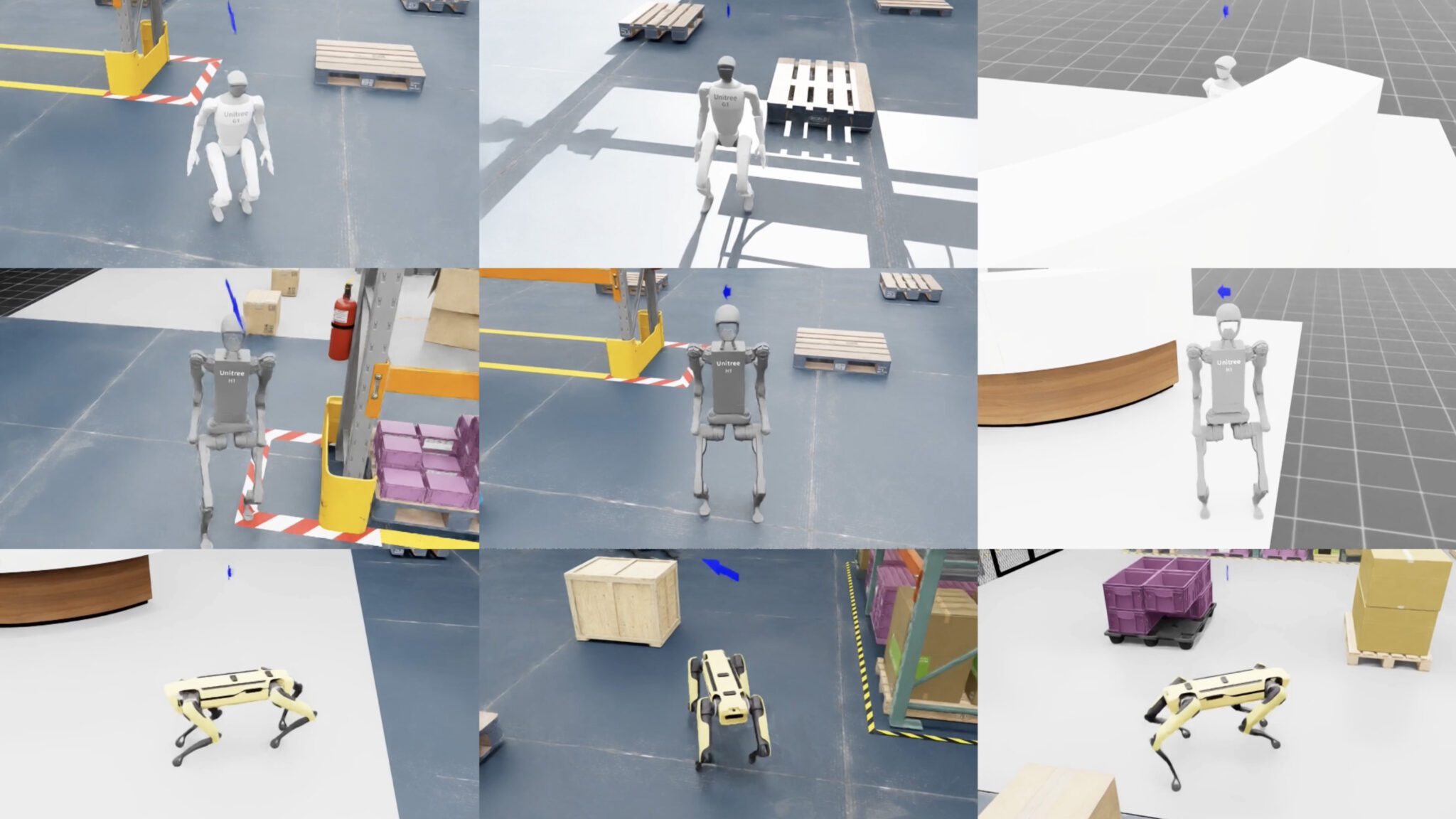
<p>A recent <a href="https://blogs.nvidia.com/blog/icra-research-robotics-simulation-to-real-world/">NVIDIA Research announcement</a> puts a practical question ahead of the physical-AI hype: can a policy trained in simulation survive contact with a real robot, a different body shape and an unpredictable worksite? The work presented around ICRA 2026 offers useful development tools for mobile platforms, humanoids and manipulation systems, but it also makes clear that simulation-to-real transfer is a validation path—not a deployment certificate.</p><h2>What developers can actually reuse</h2><p>The most relevant result for field robotics is COMPASS, a navigation policy framework trained in NVIDIA Isaac Lab. It combines imitation learning with residual reinforcement learning to create specialists for different robot embodiments. NVIDIA reports a 4.5-fold improvement in average success rate over an imitation-learning baseline and around 80% success across 20 real-world navigation trials involving autonomous mobile robots and humanoids.</p><p>That is meaningful because navigation software is rarely portable by default. Wheelbase, leg geometry, sensor placement, turning radius and payload all change how a robot moves through a site. COMPASS is designed to address that compatibility problem in simulation before a team sends a policy to a new platform. Developers can also connect the workflow to a digital twin through NVIDIA Omniverse NuRec to validate a robot in a novel environment before deployment.</p><p>The practical limit is equally important: compatibility here means that a policy can be adapted and evaluated across embodiments. It does not mean that any robot can run the same stack without a supported interface, calibrated sensors, suitable compute, a controller integration and a site model. Teams should treat the reported 80% result as evidence from a small trial set, not as a general reliability guarantee.</p><h2>From warehouse-style tasks to field conditions</h2><p>Another project, Grasp-MPC, addresses the final centimetres of a grasp. Instead of executing a fixed trajectory, it continuously corrects the motion as the gripper closes. NVIDIA says the system was trained on two million simulated trajectories covering 8,000 objects and achieved approximately 75% overall success on real robots, compared with 41% for a baseline.</p><p>That approach could help field platforms that must handle unfamiliar objects, but the reported scenarios remain structured tabletop and shelf tasks. Outdoor debris, wet surfaces, glare, wind, flexible materials and poor visibility introduce failure modes that a clean benchmark does not resolve. Developers should therefore keep a recovery action available: stop, release, retreat or request human intervention when the perception or force estimate falls outside its tested range.</p><p>The strongest field-facing example is Deformable Cluster Manipulation. NVIDIA describes a system trained on synthetic tree shapes and deployed zero-shot to real branches, with possible applications including clearing vegetation around power lines, cable management and agricultural inspection. The announcement presents these as research directions and demonstrations, not as proof that a robot is ready to work independently near live infrastructure. That distinction matters. A branch-clearing policy may be promising while still requiring a qualified operator, exclusion zones, a mechanical risk assessment and a procedure for unexpected contact.</p><h2>Why simulation does not remove the safety work</h2><p>NVIDIA’s own description identifies the central sim-to-real gap: real surfaces are imperfect, sensors behave differently from their specifications and small discrepancies can stop a robot. SPARR addresses this by adding a corrective layer on the real robot after the general strategy is learned in simulation. The reported gains—38% higher success and roughly 30% shorter cycle time than a zero-shot baseline—show the value of calibration, but they also show why a purely simulated acceptance test is insufficient.</p><p>For a field deployment, the minimum review should cover four boundaries:</p><ul><li><strong>Platform compatibility:</strong> confirm the robot body, actuators, camera layout, compute budget, middleware and control frequency used during validation.</li><li><strong>Environment coverage:</strong> test the actual floor, lighting, weather, obstacles, network conditions and human traffic expected on site.</li><li><strong>Failure behaviour:</strong> verify that loss of localisation, sensor disagreement, uncertain grasping or unexpected contact produces a safe stop or controlled recovery.</li><li><strong>Operational authorization:</strong> complete the site risk assessment and any applicable machinery, workplace, radio or aviation approvals. The NVIDIA announcement does not claim conformity certification or legal authorization for a particular deployment.</li></ul><h2>A sensible developer workflow</h2><p>Start by reproducing the published task in simulation and recording the exact robot embodiment, sensor configuration and success definition. Next, build a digital twin or equivalent test scene that contains the obstacles and routes found in the intended worksite. Then run a staged transfer: simulation, supervised low-speed trials, restricted-area trials and only then normal operations. Keep a human fallback throughout the first stages and log every intervention rather than reporting only successful runs.</p><p>For navigation, compare performance across the robot bodies you intend to support instead of assuming that one successful transfer generalizes to the fleet. For manipulation, include failed grasps and recovery attempts in the dataset. For outdoor work, test degraded sensing and communication loss deliberately. A policy that succeeds in nominal conditions but has no documented response to uncertainty is not ready for a shared field environment.</p><p>The announcement is therefore useful for teams building robotics platforms, especially those already using NVIDIA’s simulation and edge-compute ecosystem. It offers concrete research components, open implementation leads and measured results. Its real value is methodological: validate the interface, measure the transfer, expose the failure modes and document the operational boundary. The next step is not to claim autonomy; it is to prove that the specific robot, site and safety case are compatible.</p><section class="media-fleet-sources"><h2>Official sources</h2><ul><li><a href="https://blogs.nvidia.com/blog/icra-research-robotics-simulation-to-real-world/">Official source: blogs.nvidia.com</a></li></ul></section><aside class="media-fleet-related"><h2>Related reading</h2><ul><li><a href="https://rentbuyrobot.com/article/nasa-space-roboticist-challenge-orbital-research">Nasa Space Roboticist Challenge Orbital Research</a></li><li><a href="https://rentbuyrobot.com/article/apollo-2-robot-park-real-work-not-production-proof">Apollo 2 Robot Park Real Work Not Production Proof</a></li></ul></aside>
PrototypeReport
NVIDIA’s Sim-to-Real Path for Field Robots Starts With Validation
NVIDIA’s latest robotics research shows how simulation can transfer to mobile and humanoid platforms, while small trials and missing certification claims define the checks field teams still need.