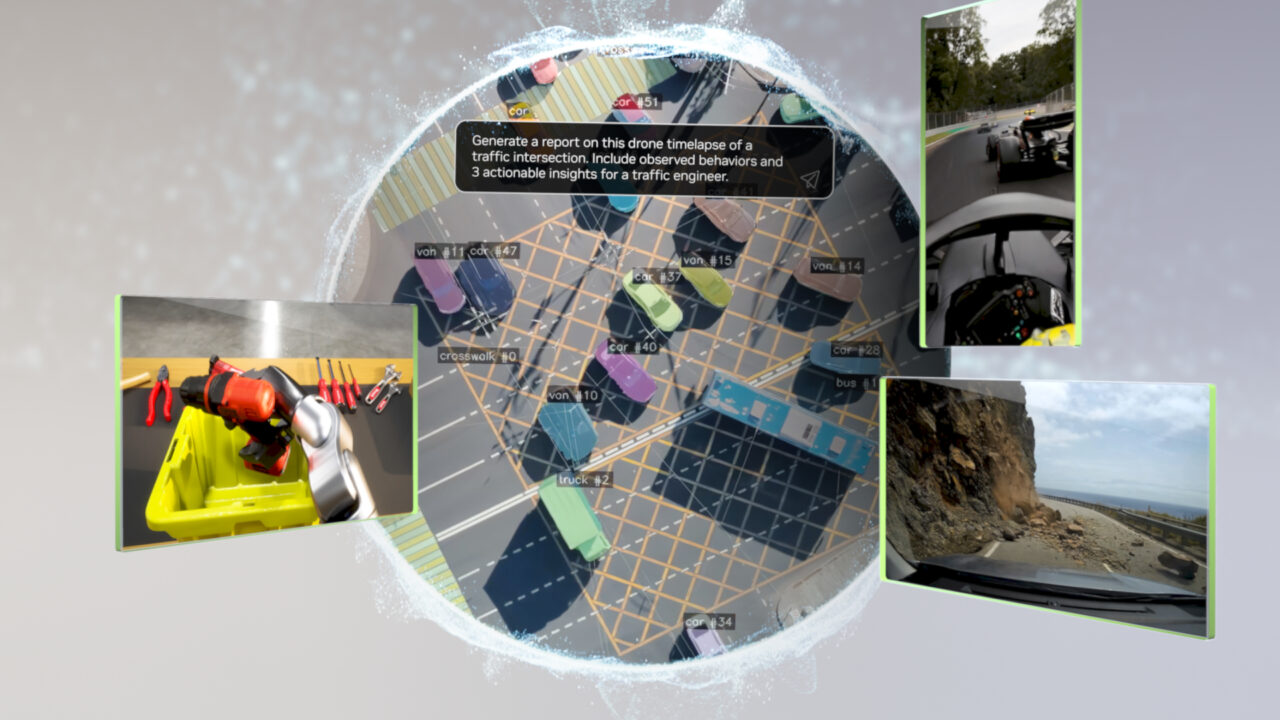
<p>NVIDIA’s <a href="https://blogs.nvidia.com/blog/open-world-models-physical-ai/">August 6, 2026 physical-AI update</a> puts open world models and simulation at the center of robot development. The stated use case is practical: generate training data, test policies and build environments that help teams validate autonomous systems before exposing hardware to uncertain conditions.</p><p>For field-robot developers, that matters because outdoor deployments are difficult to reproduce safely. A ground robot may encounter changing light, weather, terrain, vegetation, people or unexpected obstacles. A drone adds airspace constraints, communications loss and recovery procedures. NVIDIA says its Cosmos 3 models can generate physically grounded scenarios, predict future states and support specialization for a particular robot, sensor configuration or operating environment.</p><h2>What NVIDIA is actually adding</h2><p>The update describes Cosmos 3 as an open model family for physical AI. NVIDIA lists Cosmos 3 Super at 64 billion parameters, Cosmos 3 Nano at 16 billion and Cosmos 3 Edge at 4 billion. The company says the Edge model is designed for on-device vision reasoning and robot-policy deployment across NVIDIA RTX GPUs, DGX systems and Jetson platforms, including Jetson Thor.</p><p>The important developer layer is the connection with NVIDIA Omniverse libraries. NVIDIA says those libraries, delivered as part of its Agent Toolkit, provide prebuilt capabilities for building simulation-ready worlds. OpenUSD is presented as the interchange framework for composing and reusing 3D assets across digital twins, simulation and synthetic-data workflows. That can reduce duplicated asset and sensor setup when a team changes the robot, camera or environment.</p><p>This is a compatibility promise at the software-stack level, not a universal plug-and-play guarantee. A field team still has to check model licensing, available weights, accelerator support, operating-system and SDK versions, sensor drivers, camera timing, localization inputs and the interface used to send commands to the real robot. Cosmos 3 Edge being available on a class of NVIDIA hardware does not establish that every camera, carrier board, robot middleware layer or power budget will work without adaptation.</p><h2>A useful workflow for field robotics</h2><p>The most defensible way to use the announcement is as a staged validation workflow rather than as evidence that a robot is ready for autonomous operation.</p><ol><li><strong>Freeze the real configuration.</strong> Record the robot embodiment, payload, sensors, compute module, software versions, control frequency and communications path. Do not begin with a generic digital twin that hides the constraints of the deployed machine.</li><li><strong>Build the environment around measured data.</strong> Recreate representative terrain, lighting, weather and obstacle classes. Include sensor noise, latency, dropped frames and localization uncertainty where those conditions are present in field logs.</li><li><strong>Generate rare cases deliberately.</strong> World models can help create variations that are expensive or unsafe to stage repeatedly. They should expand the test set, not replace recorded examples from the actual operating site.</li><li><strong>Compare against held-out reality.</strong> Check perception, predicted motion and policy decisions against data that was not used for post-training. A visually convincing simulation can still produce the wrong friction, depth, wind, radio or contact behavior.</li><li><strong>Gate every transfer to hardware.</strong> Start with low-speed, supervised runs in a controlled area. Keep an independent stop mechanism, a human operator, defined abort conditions and a recovery plan for loss of localization, communications or compute.</li></ol><h2>Where the limits remain</h2><p>NVIDIA’s update does not provide an independent field trial, a flight approval, a ground-robot safety case or a performance result for a particular customer platform. Its benchmark references and reported adoption describe NVIDIA’s own evaluation and ecosystem claims; they are not a substitute for acceptance testing by a deployer.</p><p>Simulation also cannot certify the hazards that matter most at the edge of a site. A drone operator must still check the applicable aviation rules, operating category, remote-identification obligations, geofencing policy, visual-line-of-sight or beyond-visual-line-of-sight permissions and emergency procedures. A ground robot team must assess people, vehicles, slopes, machinery, site access and recovery logistics. In both cases, the AI model should remain inside a safety architecture that can constrain or stop motion independently of the model’s prediction.</p><p>The practical takeaway is therefore narrower than “world models solve field autonomy.” NVIDIA is offering a route to produce more varied test conditions and to move some reasoning closer to the robot. That can shorten iteration for teams with a well-defined hardware and data pipeline. It does not remove the need to calibrate sensors, validate sim-to-real behavior, document failure modes or obtain the permissions required for the real operating environment.</p><p>For a robotics platform buyer or developer, the next question is not whether Cosmos 3 looks capable in a demonstration. It is whether the complete stack—model, simulator, middleware, sensors, compute, operator controls and site rules—can be reproduced, measured and stopped when conditions leave the validated envelope.</p><section class="media-fleet-sources"><h2>Official sources</h2><ul><li><a href="https://blogs.nvidia.com/blog/open-world-models-physical-ai/">Official source: blogs.nvidia.com</a></li></ul></section><aside class="media-fleet-related"><h2>Related reading</h2><ul><li><a href="https://rentbuyrobot.com/article/cmu-rio-open-robot-research-infrastructure">Cmu Rio Open Robot Research Infrastructure</a></li><li><a href="https://rentbuyrobot.com/article/agility-digit-live-warehouse-work-safety-limits">Agility Digit Live Warehouse Work Safety Limits</a></li></ul></aside>
PrototypeReport
NVIDIA Links Open World Models to Field-Robot Simulation
NVIDIA’s latest physical-AI update connects Cosmos 3 and Omniverse to simulation workflows for field robots, while leaving compatibility, safety and regulatory validation to deployment teams.