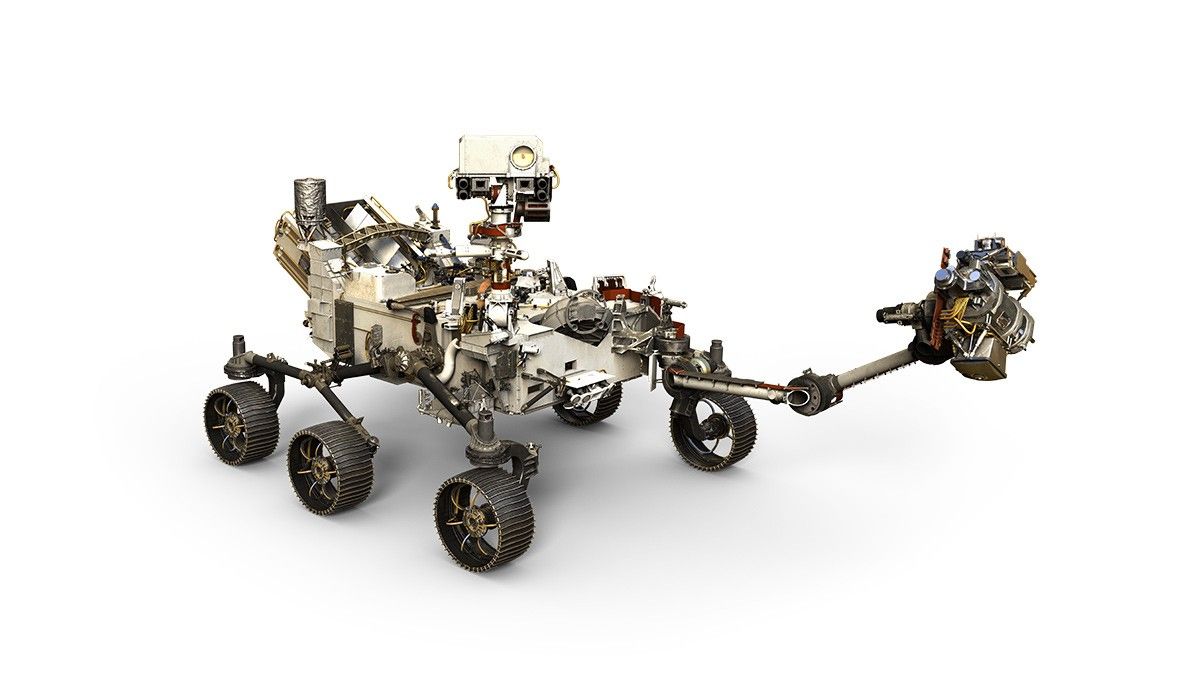
<p>NASA has selected seven companies for contract awards under its Science Transport and Robotic Innovation for Deployment and Exploration initiative, known as STRIDE. The agency’s <a href="https://science.nasa.gov/directorates/smd/planetary-science-division/mars-exploration-program/nasa-awards-contracts-for-mars-advanced-surface-mobility-technology/">July 8 announcement</a> describes the work as technology development for future Mars missions, not as the delivery of a flight-ready rover.</p><p>The distinction matters. NASA says the awards will support design studies and early-stage prototyping of commercial robotic surface mobility systems, including platforms able to transport and deploy payloads. The stated objective is to improve access to difficult terrain, extend travel across the Martian surface and investigate scientifically valuable regions that current mobility systems may not reach.</p><h2>Seven contractors, one research objective</h2><p>The awardees are AeroVironment, Astrobotic, Venturi Astrolab, Ground Control Robotics, Honeybee Robotics, Intuitive Machines and MEI Technologies. NASA gives the combined awards an approximate potential value of $17 million, with work targeted to begin in fall 2026. “Potential” is important here: the notice describes the ceiling of the awards, not guaranteed spending, delivered hardware or mission deployment.</p><p>NASA’s <a href="https://science.nasa.gov/planetary-science/programs/mars-exploration/mars-exploration-program-stride/">STRIDE programme page</a> frames the initiative as a partnership with US industry to identify capability gaps and development needs for commercial systems that could operate in realistic Martian environments. In practical terms, the programme is aimed at the engineering questions between a promising mobility concept and a system that could eventually be integrated into a planetary mission.</p><h2>What the research is meant to investigate</h2><p>A Mars mobility system has to do more than move from one point to another. It must handle uncertain terrain, limited communications, constrained energy, dust and temperatures, while carrying equipment that has scientific value. Payload transport and deployment add another layer: the vehicle must approach a target, position itself accurately and release or operate equipment without assuming the predictable surfaces and infrastructure available on Earth.</p><p>The award notice does not publish a common vehicle architecture or a shared autonomy stack. It also does not say that the seven companies will build identical robots. The programme instead creates a portfolio of studies and early prototypes, allowing NASA to compare different approaches to mobility, payload handling and access to terrain. That makes the initiative useful as a research signal: it identifies where NASA sees unresolved engineering needs, rather than claiming that those needs have already been solved.</p><p>Surface and aerial mobility are both included in the scope. That could cover different operational roles, from ground vehicles designed to carry instruments across rough terrain to airborne systems intended to scout or reach areas that are difficult for a wheeled platform. The announcement does not provide enough information to determine which awardee will pursue which configuration, nor does it publish performance targets for range, payload mass, autonomy, flight duration or navigation accuracy.</p><h2>What NASA has not yet demonstrated</h2><p>Readers should not treat the announcement as evidence that a new Mars rover is ready for launch. NASA does not report a field trial, flight test, Mars-environment qualification, mission assignment or completed prototype. It also does not announce a launch date. The targeted start of work in fall 2026 is a development milestone, not an operational timetable.</p><p>The notice leaves several practical questions open. There are no published test conditions for traction, obstacle negotiation or landing. No safety case is described for autonomous operation around payloads, and no details are given about fault detection, recovery behaviour or communications loss. Those omissions are normal for an early technology-development award, but they define the current evidence boundary.</p><p>The same caution applies to autonomy. NASA’s language points to systems that could operate in realistic Martian environments, yet it does not specify how much decision-making would occur onboard, how operators would supervise the machines or how the systems would respond when terrain, dust or sensor quality fell outside expected conditions. Until those methods and results are published, autonomy should be treated as a development goal rather than a verified capability.</p><h2>Why the announcement is useful now</h2><p>STRIDE is relevant because it makes planetary robotics easier to read through measurable stages. NASA has identified a problem area, selected contractors, stated the intended development phase and named the operational challenges the work is meant to address. The next meaningful evidence will be technical: prototype designs, documented tests, environmental validation and clear limits on where each system works.</p><p>For researchers and robotics developers, the announcement is also a reminder that planetary mobility is a systems problem. A capable robot needs locomotion, perception, navigation, energy management, communications and payload interfaces to work together under severe constraints. The award notice establishes that NASA is funding work toward those capabilities. It does not establish that any one contractor has already produced a deployable Mars robot.</p><section class="media-fleet-sources"><h2>Official sources</h2><ul><li><a href="https://science.nasa.gov/directorates/smd/planetary-science-division/mars-exploration-program/nasa-awards-contracts-for-mars-advanced-surface-mobility-technology/">Official source: science.nasa.gov</a></li><li><a href="https://science.nasa.gov/planetary-science/programs/mars-exploration/mars-exploration-program-stride/">Official source: science.nasa.gov</a></li></ul></section><aside class="media-fleet-related"><h2>Related reading</h2><ul><li><a href="https://rentbuyrobot.com/article/agility-humanoid-policy-deployment-test">Agility Humanoid Policy Deployment Test</a></li><li><a href="https://rentbuyrobot.com/article/nvidia-open-world-models-field-robot-simulation">Nvidia Open World Models Field Robot Simulation</a></li></ul></aside>
PrototypeReport
NASA’s STRIDE Awards Put Mars Robot Mobility Under Research
NASA has selected seven companies for Mars mobility studies. We separate the announced research scope from what the contracts do not yet prove.