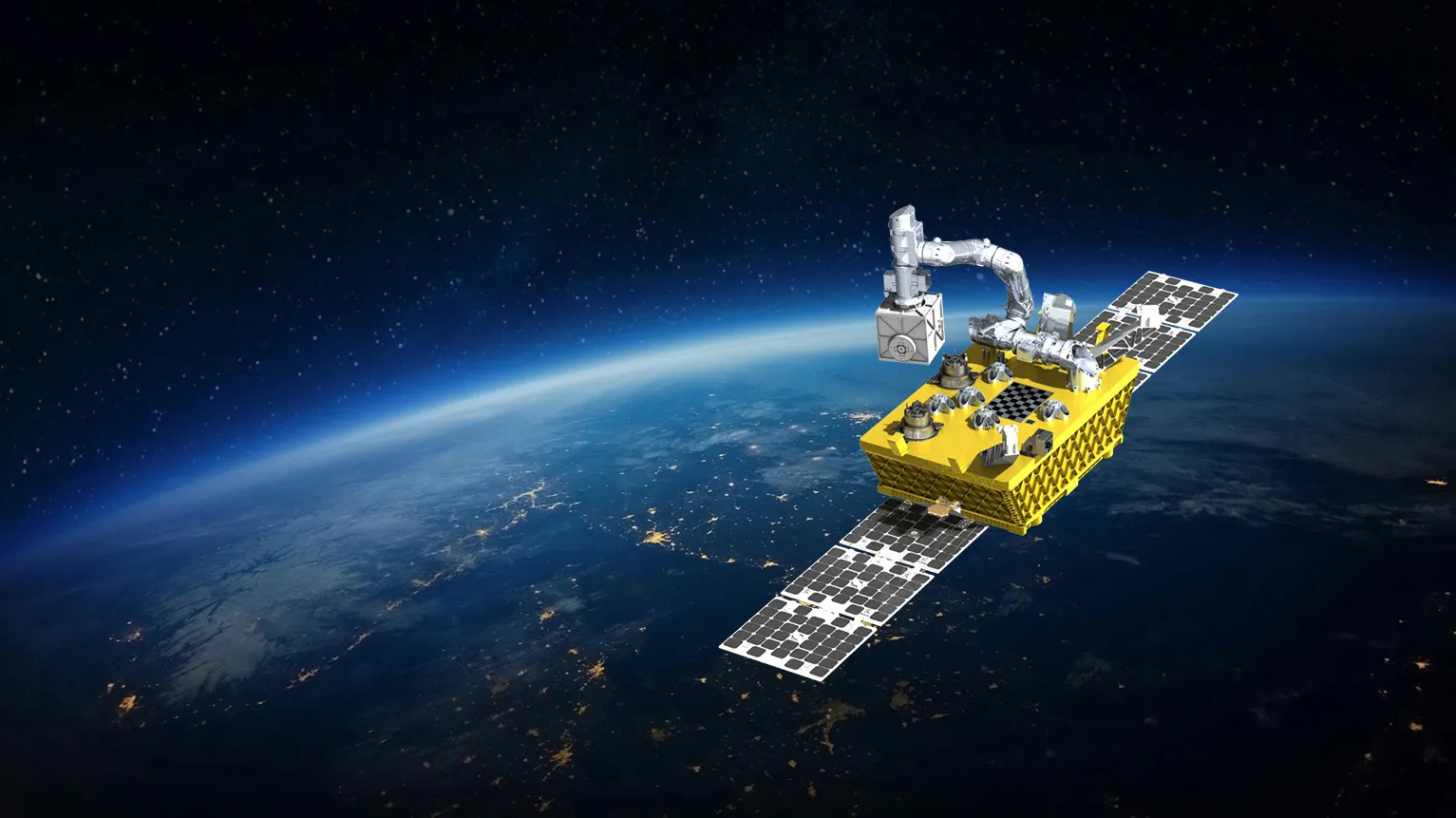
<p>NASA is opening a tightly defined route for researchers to propose experiments with a robotic arm in low Earth orbit. The <a href='https://www.nasa.gov/directorates/stmd/prizes-challenges-crowdsourcing-program/center-of-excellence-for-collaborative-innovation-coeci/nasa-space-roboticist-challenge/'>Space Roboticist Challenge</a>, announced on June 2, 2026, is built around the Fly Foundational Robots mission and its planned seven-degree-of-freedom arm. The opportunity is aimed at a select group of U.S. principal investigators, post-doctoral researchers, professors and highly qualified graduate students.</p><p>This is an access and validation programme, not an announcement that a general-purpose orbital robot is already operating. NASA is asking eligible teams to propose short, focused experiments, then move through documentation, paper review, simulation and validation before any flight opportunity is offered. That sequence gives the announcement a useful research value: it defines how a robotic idea must be made testable before it can reach an on-orbit environment.</p><h2>What NASA is offering</h2><p>The robotic system is described publicly in only the terms needed for the challenge: a seven-degree-of-freedom robotic arm that will be launched to low Earth orbit as part of the FFR mission. NASA does not present a payload catalogue, production specification, price or guaranteed performance result. The public announcement instead concentrates on how researchers can gain access to the hardware and what evidence they must provide.</p><p>NASA’s process has three stages. During Phase 0, applicants submit eligibility documentation. Once NASA reviews and confirms eligibility, participants receive access to the Phase 1 submission portal. In Phase 1, teams submit a white paper proposing a short, focused experiment using the robotic arm. NASA says that up to 15 teams will advance to Phase 2, where invited participants will conduct simulation and validation testing, including visits to Goddard Space Flight Center in Greenbelt, Maryland.</p><p>Teams that pass validation will receive an offer of on-orbit experiment time on the FFR mission. The wording matters. Passing the challenge does not mean that every proposal will fly, nor does it establish that a proposed experiment will succeed in orbit. It creates a pathway from a research question to a screened and technically prepared flight opportunity.</p><h2>Why the method matters</h2><p>For orbital robotics, the difficult part is not only moving a joint or closing a gripper. Researchers must define the task, identify what the arm must sense and control, explain how success will be measured and account for the limits of testing hardware that cannot be serviced like a laboratory robot. NASA’s requirement for a focused white paper is therefore more than an administrative step. It encourages applicants to turn a broad ambition into an experiment with a clear objective and observable result.</p><p>The simulation and validation stage is equally important. It gives NASA and the research teams a chance to expose unclear assumptions before an orbital demonstration is considered. A simulation result is not the same as a flight result, but it can show whether the proposed control sequence, sensing plan and evaluation method are coherent enough to proceed. Validation on the ground can also reveal whether the team has the operational capability to execute the experiment safely and consistently.</p><p>That evidence ladder is particularly relevant to open robotics research, where software, datasets and control methods are often compared across different platforms. An orbital experiment cannot be treated as a simple product demo. Researchers need to report the exact task, operating conditions, intervention rules and failure criteria. Without that information, a successful movement would be difficult to reproduce or compare with work performed on Earth.</p><h2>Limits that are already visible</h2><p>NASA’s announcement leaves several boundaries explicit. Participation is limited to selected U.S. researchers who meet the eligibility requirements. The page does not promise access to hobbyists, international applicants or commercial users outside the stated programme. It also does not describe the arm’s payload capacity, end effector, camera configuration, force sensing, communications latency or permitted experiment classes. Those details may be provided through the challenge process, but they should not be inferred from the seven-degree-of-freedom description alone.</p><p>The announcement also provides no completed experiment results. There is no public flight score, reliability figure or claim that the arm has demonstrated autonomous manipulation in orbit. The correct current interpretation is narrower: NASA is preparing a structured opportunity to evaluate research proposals and potentially conduct experiments with an orbital robotic arm.</p><h2>What applicants should verify</h2><p>Researchers considering the opportunity should begin with the eligibility documentation and the official schedule. NASA lists September 23, 2026, as the registration closing date, with registration closing at 12:59 p.m. Eastern Time. The agency lists October 2 as the Phase 1 white-paper deadline, also at 12:59 p.m. Eastern Time. The <a href='https://www.nasa.gov/stmd-solicitations-and-opportunities/'>NASA STMD opportunities page</a> also lists the challenge among current opportunities.</p><p>A responsible proposal should separate what will be measured from what the team merely hopes to demonstrate. It should identify the robot state, the external environment, the operator’s role, the expected communication constraints and the conditions under which the experiment will stop. It should also explain how simulation results will be compared with validation data and how a failure will be recorded rather than hidden.</p><p>NASA’s Space Roboticist Challenge is therefore best read as an invitation to make orbital robotics research more deliberate. Its immediate contribution is not a new commercial robot, but a public route for turning a carefully scoped experiment into a candidate flight activity. Until NASA publishes validation outcomes or flight data, the credible story is the method: eligibility, focused proposals, simulation, ground validation and only then a possible on-orbit test.</p><section class="media-fleet-sources"><h2>Official sources</h2><ul><li><a href="https://www.nasa.gov/directorates/stmd/prizes-challenges-crowdsourcing-program/center-of-excellence-for-collaborative-innovation-coeci/nasa-space-roboticist-challenge/">Official source: nasa.gov</a></li><li><a href="https://www.nasa.gov/stmd-solicitations-and-opportunities/">Official source: nasa.gov</a></li></ul></section><aside class="media-fleet-related"><h2>Related reading</h2><ul><li><a href="https://rentbuyrobot.com/article/apollo-2-robot-park-real-work-not-production-proof">Apollo 2 Robot Park Real Work Not Production Proof</a></li><li><a href="https://rentbuyrobot.com/article/kawasaki-dexterity-eight-axis-industrial-arm-warehouse-deployment">Kawasaki Dexterity Eight Axis Industrial Arm Warehouse Deployment</a></li></ul></aside>
PrototypeReport
NASA Opens a Research Path to an Orbital Robotic Arm
NASA’s 2026 Space Roboticist Challenge offers selected U.S. researchers a route from white paper to simulation, validation and a possible on-orbit experiment with a seven-degree-of-freedom robotic arm.