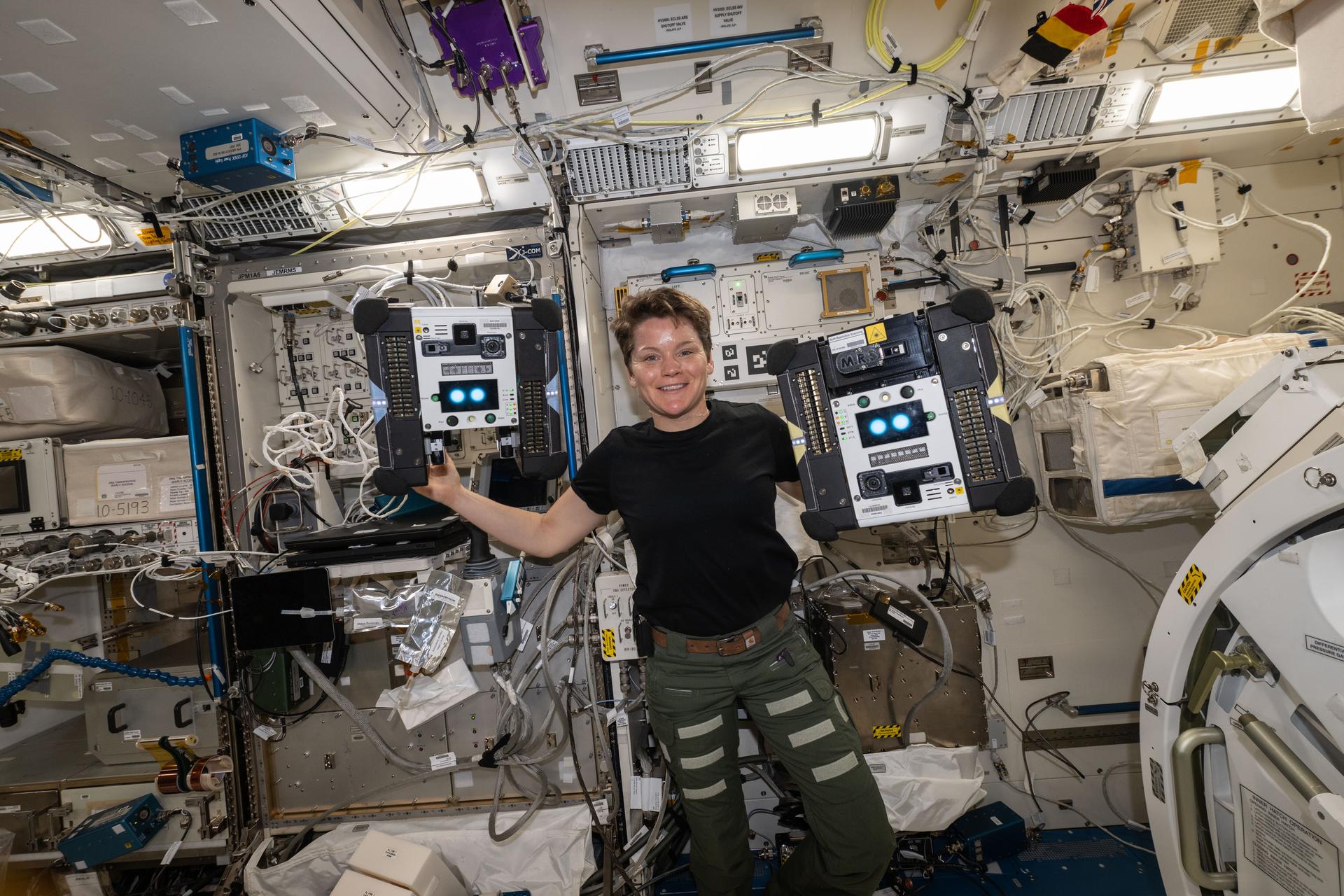
<p>NASA is continuing the Astrobee mission through a partnership with Arkisys to sustain and maintain the free-flying robotic platform aboard the International Space Station. The practical significance is continuity: researchers can keep using an operating microgravity testbed for robotics hardware and software. It is not an announcement of a commercially available spacecraft caretaker, and NASA does not present it as proof that autonomous maintenance in deep space is ready for deployment.</p><p>This distinction matters because Astrobee sits between laboratory research and operational service. The robots have already flown inside the station, but the value of the platform is that it lets external teams investigate specific capabilities under real orbital conditions. NASA’s <a href="https://www.nasa.gov/image-article/nasas-astrobee-robots-advance-through-strategic-partnership/">partnership announcement</a> says Arkisys will help keep the platform available so partners can continue experimenting with it.</p><h2>What Astrobee actually provides</h2><p>The <a href="https://www.nasa.gov/astrobee/">Astrobee system</a> consists of three cube-shaped robots, onboard software and a docking station used for recharging. Electric fans provide propulsion in the station’s microgravity environment. Cameras and other sensors support navigation, while a perching arm lets a robot grip a handrail, hold position and conserve energy. The design is modular, so researchers can add or change hardware and software for different experiments.</p><p>NASA describes several operating modes. Astrobee can work autonomously, or it can be controlled remotely by astronauts, flight controllers or researchers on the ground. Documented tasks include inventory, experiment documentation, station monitoring and moving cargo. These are bounded activities inside a prepared spacecraft, not general-purpose manipulation across arbitrary environments.</p><p>The platform’s research role is equally important. NASA says Astrobee has supported hundreds of microgravity experiments and thousands of hours of testing. The system is used by researchers and student teams from outside NASA, giving them a way to evaluate sensors, interfaces, navigation methods and robotic hardware where gravity, contact dynamics and human access differ sharply from Earth-based laboratories.</p><h2>Why the partnership matters to open robotics research</h2><p>Astrobee should be understood as an externally usable research facility rather than an open-source product. NASA’s public material describes a platform that partners can use for investigations, but it does not claim that every component is released under an open-source licence or that anyone can freely deploy the flight system. Access, integration and mission operations remain governed by NASA and the station environment.</p><p>That boundary does not reduce the platform’s value. A repeatable orbital facility can make research more comparable than isolated demonstrations. Teams can test a new sensor or control method against a robot with known dimensions, propulsion hardware, docking behaviour and station interfaces. The results still require careful interpretation, but they are connected to a real operating environment rather than only to simulation.</p><p>NASA’s related <a href="https://www.nasa.gov/missions/station/meet-isaac-integrating-robots-with-the-space-stations-of-the-future/">ISAAC work</a> illustrates the research direction. Multiple Astrobees were used to study spacecraft monitoring, interior surveys and navigation between station modules. NASA reports that the robots helped demonstrate a robot-generated survey of a spacecraft interior and locate a sound source in space. Those are useful research milestones because they identify concrete sensing and coordination tasks, not because they establish a finished autonomous service.</p><h2>The limits behind the headline</h2><p>The announcement does not publish a general performance benchmark covering navigation accuracy, collision avoidance, battery endurance, task completion rates or failure recovery. It also does not show that Astrobee can independently diagnose and repair a spacecraft fault. NASA discusses future caretaker roles for spacecraft, but that is a direction for further development, not a demonstrated product capability.</p><p>The operating environment imposes additional constraints. Astrobee flies inside the International Space Station, where routes, modules, handrails, docking locations and procedures are known in advance. Crew members and ground teams remain part of the operational system. Remote control is available, and the robots can return to a docking station for recharge, but those features should not be confused with unsupervised autonomy in an unknown environment.</p><p>Safety must therefore be assessed at the system level. A space robot shares an enclosed habitat with astronauts, scientific equipment and life-support infrastructure. Any experiment needs controlled interfaces, clear abort conditions, communications planning and procedures for recovering a robot that loses localisation, power or propulsion authority. NASA’s announcement confirms continued platform support, but it does not replace mission-specific hazard analysis or certify a new research payload for flight.</p><h2>How to read the result</h2><ul><li><strong>Verified capability:</strong> Astrobee can fly inside the ISS, navigate with onboard sensing, dock for recharging and operate autonomously or under remote control.</li><li><strong>Verified use:</strong> NASA and external teams have used the platform for monitoring, inventory, experiment documentation, cargo movement and microgravity technology research.</li><li><strong>Research maturity:</strong> The platform has accumulated substantial operational experience and supports repeatable investigations in orbit.</li><li><strong>Unproven claim:</strong> The announcement does not establish a general-purpose, unsupervised spacecraft caretaker or readiness for lunar or Martian deployment.</li><li><strong>Open boundary:</strong> The facility is available to research partners, but NASA does not describe it as an unrestricted open-source hardware or software stack.</li></ul><p>The useful news is therefore straightforward: NASA is preserving access to a rare, working orbital robotics laboratory. For researchers, that can shorten the path from a ground prototype to a microgravity experiment. For readers evaluating the technology, the correct conclusion is narrower. Astrobee demonstrates how free-flying robots can support research and selected station tasks today; the broader vision of autonomous spacecraft maintenance remains a research objective whose safety, reliability and mission-specific evidence still have to be established.</p><section class="media-fleet-sources"><h2>Official sources</h2><ul><li><a href="https://www.nasa.gov/image-article/nasas-astrobee-robots-advance-through-strategic-partnership/">Official source: nasa.gov</a></li><li><a href="https://www.nasa.gov/astrobee/">Official source: nasa.gov</a></li><li><a href="https://www.nasa.gov/missions/station/meet-isaac-integrating-robots-with-the-space-stations-of-the-future/">Official source: nasa.gov</a></li></ul></section><aside class="media-fleet-related"><h2>Related reading</h2><ul><li><a href="https://rentbuyrobot.com/article/figure-03-production-scale-beyond-prototype">Figure 03 Production Scale Beyond Prototype</a></li><li><a href="https://rentbuyrobot.com/article/nvidia-jetpack-7-2-agentic-ai-field-robot-deployment-checks">Nvidia Jetpack 7 2 Agentic Ai Field Robot Deployment Checks</a></li></ul></aside>
PrototypeReport
NASA Keeps Astrobee Open for Space Robotics Research
NASA’s partnership with Arkisys keeps the Astrobee platform available for International Space Station research while its documented limits remain clear.