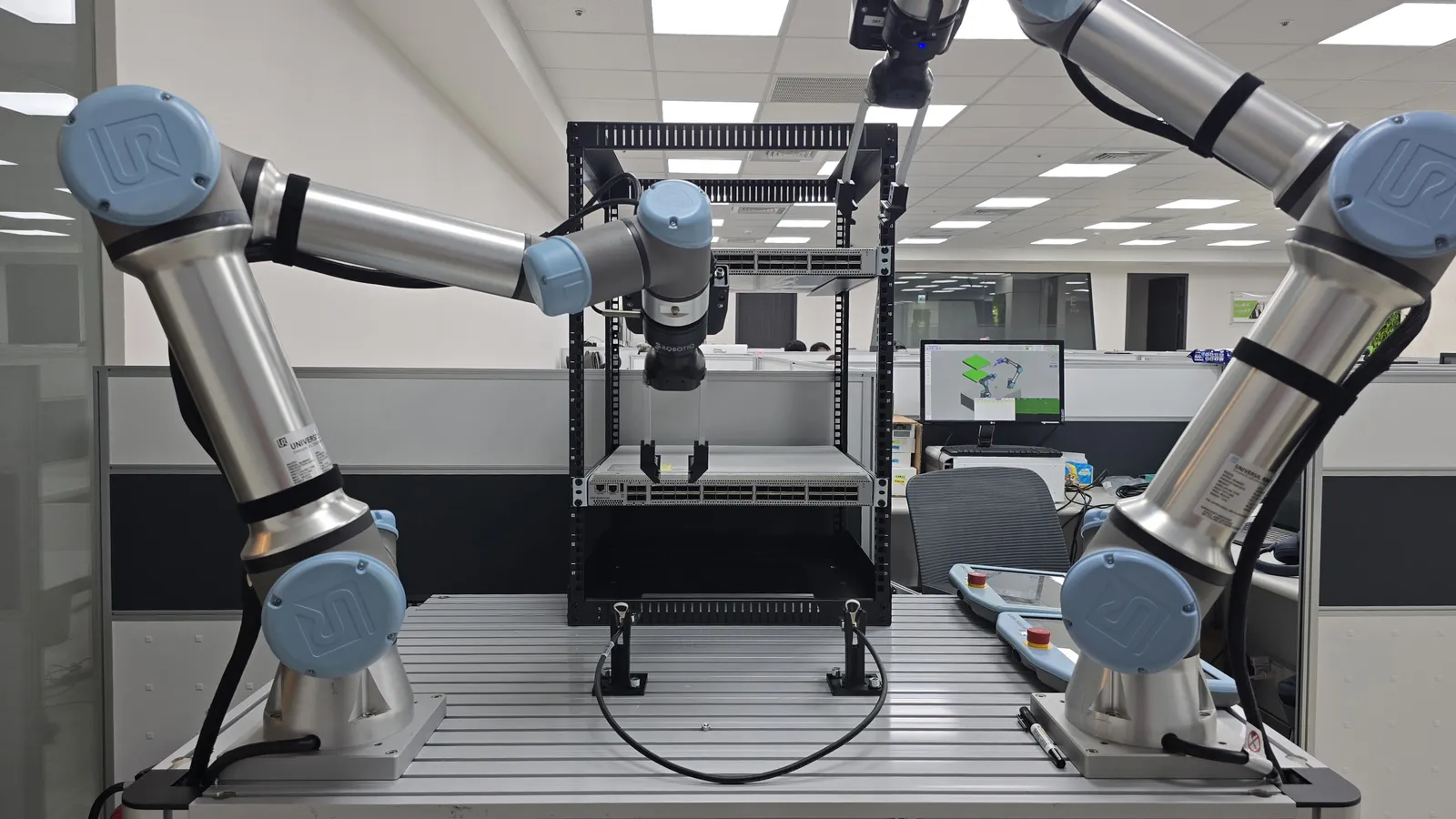
<p class="article-byline"><strong>By <a rel="author" href="/author/maya-chen">Maya Chen</a></strong></p><p>Universal Robots used Automate 2026 to make a practical claim about physical AI: adaptive robot applications are moving beyond laboratory demonstrations and into industrial deployment. In its <a href="https://www.universal-robots.com/news-and-media/news-center/teradyne-robotics-unveils-wide-range-production-ready-physical-ai-applications-automate-2026/">official announcement</a>, published on June 18, the Teradyne Robotics group described a portfolio of applications spanning electronics manufacturing, polishing, palletizing, machine tending and bin picking.</p><p>The announcement is useful because it names the robot models, the tasks and, in a few cases, a quantitative result. It is also clear about the commercial framing: Teradyne says the applications on display were real and deployable, and that manufacturers could purchase physical-AI-enabled solutions through its integrator and partner network. That is a deployment announcement, however, not an independent performance evaluation.</p><h2>What was actually demonstrated</h2><p>The strongest evidence is the range of industrial tasks rather than a single headline capability. Cambrian showed two UR7e cobots identifying and inserting copper cables into dense server racks. AICA demonstrated a UR7e executing a learned polishing trajectory after one human demonstration, with adaptive force and speed. Maple Advanced Robotics presented autonomous spot sanding using a UR8L, while Trener Robotics showed conversational task setup for a UR7e.</p><p>For material handling, beRobox used AI vision to redirect a UR20 palletizer when box orientation changed. Vention reported a 99% first-pick success rate for a UR12e and 3D-vision bin-picking system. That figure is important as a measurable claim, but its conditions are not published in the announcement: there is no part set, trial count, lighting range, recovery policy or definition of a successful pick. It should therefore be treated as a partner demonstration result, not as a general specification for the UR12e.</p><p>The event also combined cobots with mobile systems. A MiR600 and an AI-enabled pallet jack exchanged positions around the palletizing demonstration, while a MiR250 and mobile cobot repeated a conveyor transfer. These examples show a credible path for factories that need automation to move between tasks or locations. They do not establish that a mobile-cobot cell can be installed without site-specific mapping, traffic controls, access rules and validation.</p><h2>The software layer matters as much as the arm</h2><p>Universal Robots presented <a href="https://www.universal-robots.com/products/polyscope-x/">PolyScope X</a> as the common software foundation. The announcement highlights native ROS 2 support, containerized applications and Logic Programs that run continuously and in parallel with the main robot program. This can coordinate multiple cell components and, in some deployments, reduce reliance on an external PLC.</p><p>That architecture is potentially valuable in high-mix production because the robot application can react to data from vision, force sensing and other equipment without rebuilding the entire cell. The platform page also describes browser-based programming, reusable program modules and tools for changing production logic in-house. Those features may shorten integration work, but they do not remove the need to define ownership of the robot program, the AI model, the peripheral devices and the production data.</p><h2>Safety is a boundary, not an AI feature</h2><p>Universal Robots says its physical-AI approach keeps real-time motion control and certified safety inside the robot platform while AI operates above that control layer. That separation is the right principle for industrial deployment: a probabilistic model should not be allowed to bypass deterministic safety functions.</p><p>There is an important detail in the Automate announcement. PolyScope X Logic Programs are described as operating independently of safeguard stops, program pauses and robot power state. This is an integration capability, not a blanket assurance that every connected process remains safe during a stop. Before production use, an integrator must verify how a safeguard event affects grippers, conveyors, stored energy, workholding, network commands and any process that continues outside the robot controller.</p><p>The cobot’s safety rating also cannot be separated from the application. A tool, sharp workpiece, pinch point, payload, speed, reachability condition or unexpected part movement can change the risk profile. A professional deployment still needs a task-specific risk assessment, validated safety functions, controlled operating modes and documented recovery procedures. The announcement does not provide contact-force test data, stopping distances, safety validation reports or application-specific limits.</p><h2>What manufacturers can measure before rollout</h2><p>The announcement gives integrators a sensible shortlist of pilots: cable insertion, polishing, sanding, palletizing, machine tending and bin picking. Each task can be evaluated with production-relevant metrics rather than a visual pass at a trade show.</p><p>For picking, measure first-pick success, recovery time, missed detections and performance across representative parts and lighting conditions. For polishing or sanding, log force consistency, surface quality, cycle time and the number of operator interventions. For palletizing, record placement accuracy, throughput, recovery from shifted cartons and the effect of payload and gripper changes. For conversational programming, verify whether the generated task is repeatable, reviewable and safe for an operator to approve before motion begins.</p><p>Those tests should run on the actual end-of-arm tooling, fixtures, software versions and network conditions intended for production. A successful demonstration with a prepared part set is evidence that a workflow is possible; it is not evidence that the workflow is robust across shifts, materials and faults.</p><h2>A credible step toward flexible automation, with open questions</h2><p>Teradyne Robotics’ announcement shows a more grounded use of physical AI than a generic promise of autonomous factories. The demonstrations are tied to named cobots, named partners and recognisable industrial tasks. The best near-term opportunity is not replacing an entire production line, but adding adaptive behaviour to a bounded cell where success and failure can be measured.</p><p>The limits are equally clear. Published information does not yet establish long-run uptime, repeatability across sites, safety performance under real contact conditions or the maintenance burden of AI-enabled applications. Manufacturers should read the announcement as a shortlist of deployable pilots, then demand application data, risk documentation and fault-handling evidence before treating any demonstration as production-ready.</p>
PrototypeReport
Universal Robots’ 2026 physical-AI demos: what industrial-cobot deployments can prove—and what they cannot
At Automate 2026, Teradyne Robotics presented production-oriented AI applications built around Universal Robots cobots. The demonstrations show where adaptive automation is becoming deployable, but the published results still leave important safety, repeatability and failure-rate questions for integrators.