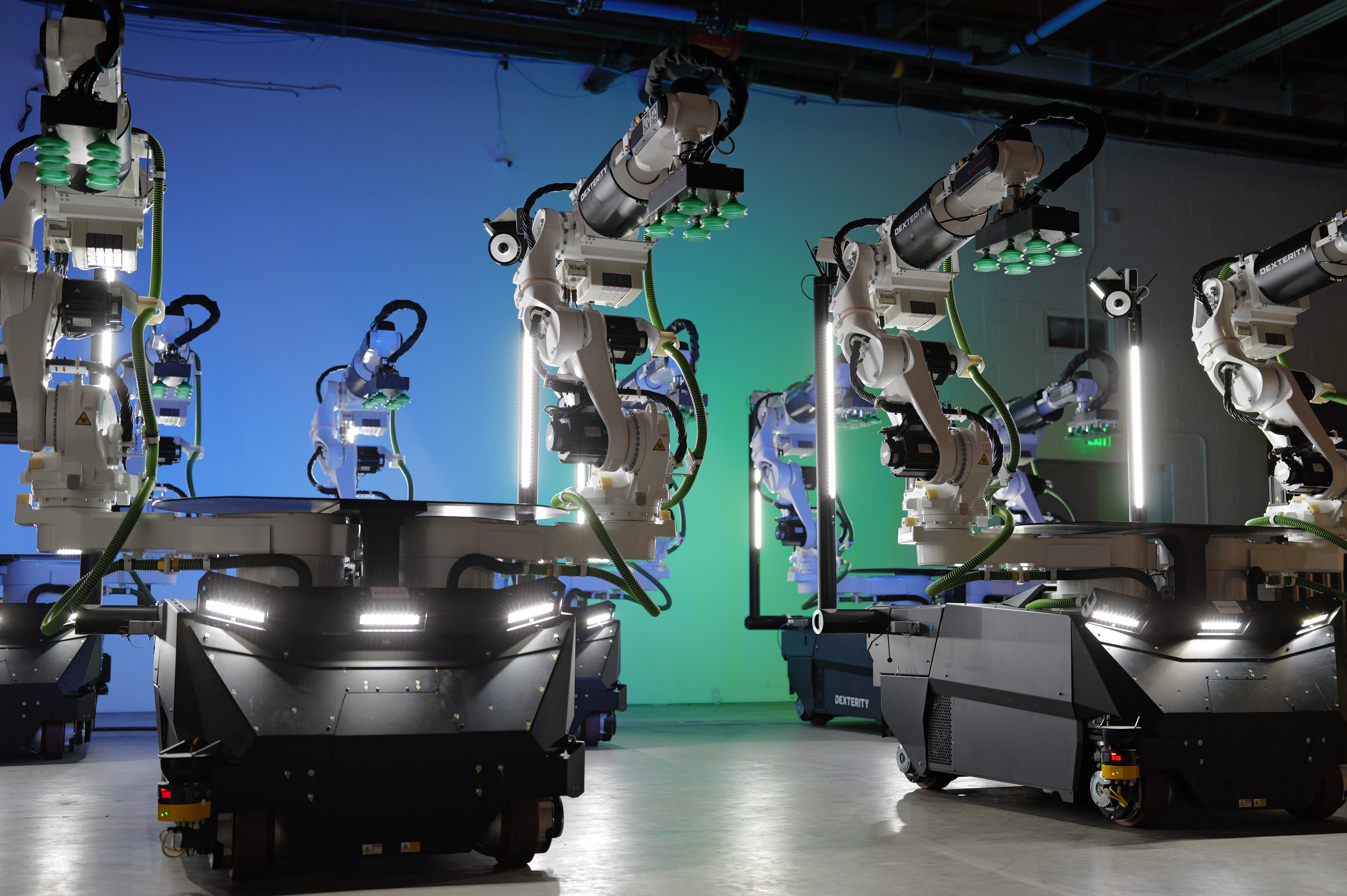
<p>Kawasaki Robotics and Dexterity have announced an expanded collaboration to scale warehouse robots built around Kawasaki’s RL030N eight-axis industrial arm. The June 23 announcement says Dexterity is expanding production and deployment of its Mech robots for trailer loading and unloading, putting the arm inside a difficult operating environment rather than a fixed factory cell.</p><p>The important point for industrial automation teams is not the humanoid appearance of Mech. It is the role of the RL030N as a production-oriented arm platform for variable logistics work. Kawasaki and Dexterity describe a system designed for packages that change in size, weight, shape, orientation and condition, with boxes that can shift, deform, fall or make unavoidable contact with surrounding equipment.</p><h2>What the RL030N is being asked to do</h2><p>Traditional industrial robots are usually deployed around controlled work envelopes, fixed tooling and predictable material flow. Warehouse loading is less forgiving. A trailer may contain mixed packaging, irregular gaps and unstable stacks. The robot must reach into confined spaces while responding to changing object positions and contact events.</p><p>Kawasaki says the RL030N adds an eighth degree of freedom to provide more dexterity and flexibility than a conventional six-axis arm. The company positions the platform for dynamic and confined environments, with lightweight construction, extended reach and real-time external orchestration. These are relevant capabilities for trailer loading and unloading, where the robot must manage changing geometry instead of repeating one fixed pick-and-place path.</p><p>The arm is also designed to connect to software outside the robot controller. Kawasaki says its open <a href="https://kawasakirobotics.com/news/kawasaki-robotics-unveils-dexterous-physical-ai-robot-platform-advanced-automation-technologies-at-automate-2026/">KRNX real-time control API</a> can interface with external AI software, ROS environments, machine-learning systems, vision platforms and third-party orchestration tools. That openness matters because the physical arm, perception stack and task planner need to exchange state quickly when a box moves or a planned path becomes blocked.</p><h2>Deployment evidence, not a benchmark</h2><p>The collaboration announcement goes further than a showroom demonstration: it says Dexterity is expanding production and scaling deployment of Mechs using the RL030N for warehouse logistics. Kawasaki also states that the arm has demonstrated strong reliability in real logistics environments. Those statements establish a commercial deployment direction and an operational target.</p><p>They do not establish a quantified performance record. The release does not provide a payload rating, maximum reach, cycle time, pick success rate, uptime figure, energy consumption or trailer-throughput measurement for the RL030N in the Mech configuration. It also does not define the conditions behind the reliability statement, such as operating hours, package mix, intervention rate or maintenance interval. Buyers should therefore treat the announcement as evidence of production intent, not as an independently verified benchmark.</p><p>The same distinction applies to safety. Dexterity describes its platform as supporting enterprise productivity and safety, while Kawasaki highlights industrial reliability and real-time control. The public announcement does not publish contact-force measurements, incident data, a completed application risk assessment or a safety validation for every trailer layout. An arm that is suitable for warehouse work is not automatically safe in every cell, around every conveyor or with every end-effector.</p><h2>What integrators should verify before deployment</h2><p>For a professional deployment, the relevant questions are specific. The integrator needs the complete load envelope for the arm, gripper and package combination, including inertia and off-centre loads. It should verify reach and clearance across the actual trailer geometry, not only an idealised model. The perception system must be tested against damaged cartons, occlusion, reflective packaging, unexpected stacks and objects that move after contact.</p><p>Safety validation also has to cover the complete system: robot motion, gripper behaviour, mobile base or platform, conveyors, trailer access, human entry points, emergency stops and recovery procedures. The release’s description of unavoidable contact in logistics is a useful warning. Contact tolerance is an engineering requirement, not proof that contact with people is acceptable. Site-specific risk reduction, guarding or monitored separation may still be necessary, depending on the task and layout.</p><p>Software integration is another boundary. An open real-time API can make adaptive control possible, but it also creates responsibility for command validation, fault handling, latency limits and safe states when the external planner loses perception or communication. A production cell needs clear ownership of those functions before AI-driven motion is allowed to control hardware.</p><h2>Why this announcement matters</h2><p>The RL030N collaboration shows where industrial robotics is moving: toward arms that retain industrial control and reliability requirements while accepting more variable environments and external software. The warehouse application is a meaningful target because trailer loading and unloading expose weaknesses that are less visible in structured factory automation.</p><p>At the same time, the announcement should not be read as proof that humanoid warehouse robots have solved general material handling. It identifies a production platform, named use cases and a scaling plan, but leaves several measurable questions unanswered. Until Kawasaki, Dexterity or an independent evaluator publishes those figures, the most defensible conclusion is narrower: the RL030N has moved from a concept for physical-AI applications toward a stated industrial deployment with Mech, while the performance and safety case still needs to be demonstrated under defined operating conditions.</p><section class="media-fleet-sources"><h2>Official sources</h2><ul><li><a href="https://kawasakirobotics.com/news/kawasaki-robotics-and-dexterity-expand-collaboration-to-scale-physical-ai-for-warehouse-logistics/">Official source: kawasakirobotics.com</a></li><li><a href="https://kawasakirobotics.com/news/kawasaki-robotics-unveils-dexterous-physical-ai-robot-platform-advanced-automation-technologies-at-automate-2026/">Official source: kawasakirobotics.com</a></li></ul></section><aside class="media-fleet-related"><h2>Related reading</h2><ul><li><a href="https://rentbuyrobot.com/article/comau-omron-partnership-deployment-safety-capability-limits">Comau Omron Partnership Deployment Safety Capability Limits</a></li><li><a href="https://rentbuyrobot.com/article/omron-ol-450s-mast-options-amr-deployment">Omron Ol 450s Mast Options Amr Deployment</a></li></ul></aside>
PrototypeReport
Kawasaki and Dexterity Scale an Eight-Axis Industrial Arm in Warehouses
Kawasaki and Dexterity are scaling Mech warehouse robots built around the RL030N eight-axis arm. The announcement shows real deployment intent, but leaves payload, uptime and safety metrics open.