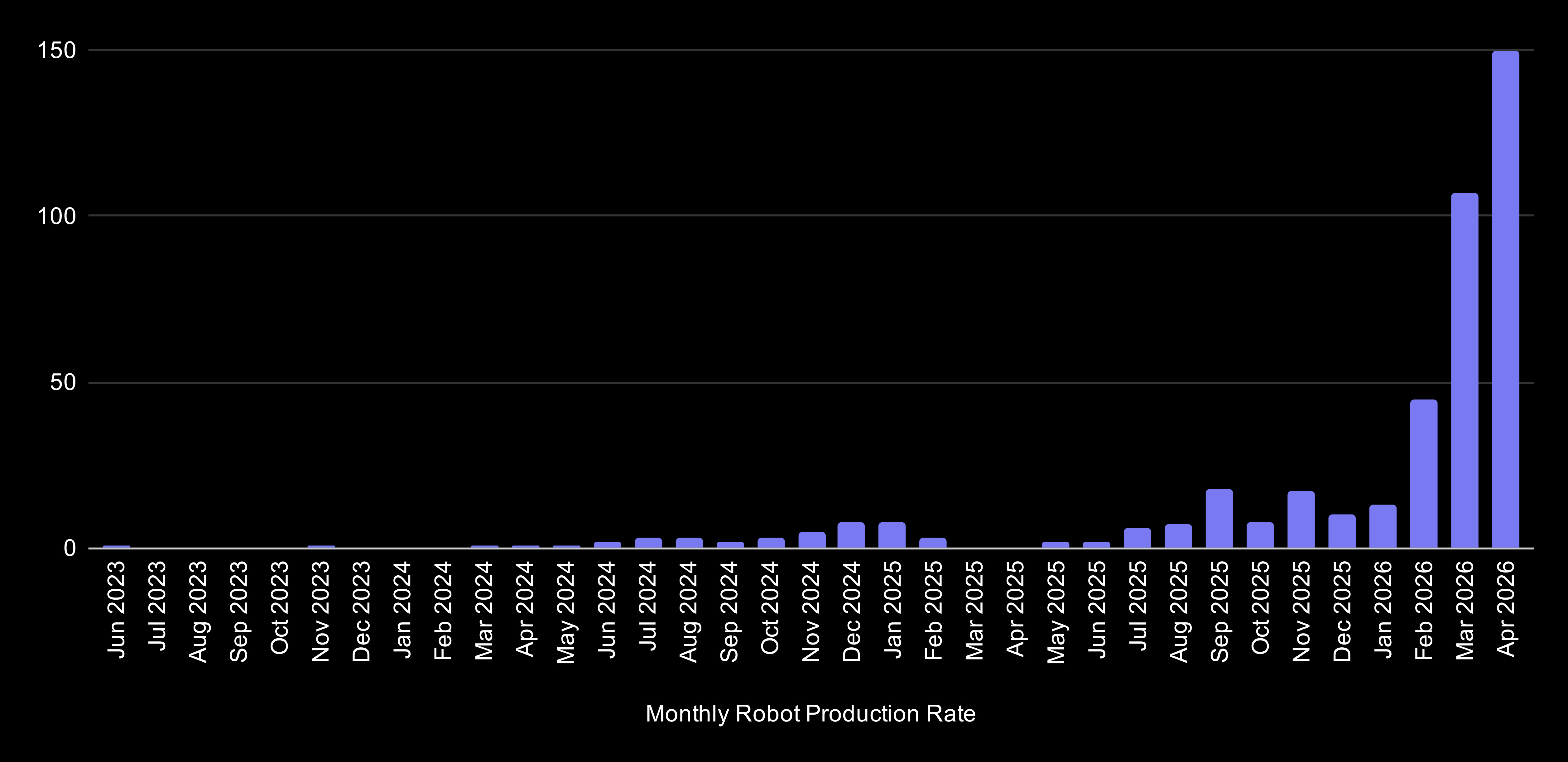
<p>Humanoid robotics is often judged by a single impressive demonstration. Figure’s latest production update points to a different milestone: whether a company can build enough identical robots to generate operational data, expose recurring failures and support a fleet beyond the prototype stage.</p><p>In its <a href="https://www.figure.ai/news/ramping-figure-03-production">April 29, 2026 announcement</a>, Figure says its BotQ manufacturing facility has delivered more than 350 third-generation Figure 03 humanoids. The company also reports that production has moved from one robot per day to one robot per hour, a claimed 24-fold increase achieved in under 120 days.</p><p>That is a meaningful manufacturing claim, but it is not the same as proving that 350 robots are independently operating in customer facilities. Figure says units are allocated across internal research, data collection, housework development and commercial use-case work. It also describes deployments in real-world environments, including customer sites and residential homes, but the announcement does not provide a customer-by-customer fleet count, uptime record or independent performance audit.</p><h2>What Figure says it has built</h2><p>Figure describes BotQ as having moved from a prototype-oriented setup to dedicated production lines for the robot’s critical modules. The company says the facility uses manufacturing-execution software across more than 150 networked workstations and has introduced more than 50 in-process inspection points.</p><p>The reported quality figures are specific but remain company-reported results. Figure says end-of-line first-pass yield is above 80%, while its battery line has reached 99.3% first-pass yield and shipped more than 500 battery packs. It also reports producing more than 9,000 actuators across more than 10 distinct stock-keeping units.</p><p>Each robot is said to undergo more than 80 functional verification tests before sign-off. Figure lists multi-limb stress tests and burn-in sessions involving repeated squats, shoulder presses and jogging. Those checks are relevant to fleet reliability because they can expose early mechanical or electrical failures before a robot reaches an operating environment. They do not, however, establish how the robot performs over months of unsupervised work, around people, or across the full range of tasks implied by a general-purpose humanoid design.</p><h2>From production scale to operational learning</h2><p>Figure’s central argument is that manufacturing scale improves robotics development. A larger fleet produces more operating hours and more failure data, allowing engineers to identify problems that a small number of prototypes may never encounter. The company says it has built diagnostics for failure analysis, software fallback ladders for non-critical faults and processes for addressing the long tail of edge cases.</p><p>It also describes a field-service system covering robots at headquarters, customer sites and homes, alongside fleet management, remote health and location tracking, fleet-wide upgrades and recall campaigns. These are the kinds of operational tools that separate a demonstration platform from a maintainable product fleet. The announcement provides no public service-level targets, intervention rates, mean time between failures or safety incident data, so the maturity of those systems cannot yet be independently assessed.</p><h2>A new mobility demonstration</h2><p>The production update also introduces a capability claim for Helix’s System 0 controller. Figure says the controller now combines proprioceptive information about the robot’s body with RGB camera input from its head-mounted cameras. A stereo model converts the images into a three-dimensional representation of the surrounding scene, which is then supplied to a whole-body control policy.</p><p>According to Figure, the policy was trained with reinforcement learning in simulation across randomized terrains and transferred to the robot without real-world fine-tuning, task-specific calibration or operator-in-the-loop adjustments. The company presents stair traversal as the first demonstration of this perception-conditioned control approach.</p><p>This is a useful distinction between a capability demonstration and a deployment claim. The reported stair behavior suggests that Figure has tested a specific mobility behavior on physical hardware. It does not show that Figure 03 can reliably navigate every staircase, handle unexpected obstacles, work safely in mixed human environments or perform a complete industrial workflow without supervision. Lighting, surface conditions, payloads, emergency procedures and recovery from faults remain important unanswered questions.</p><h2>Why the distinction matters</h2><p>The most defensible reading of Figure’s announcement is that it documents progress in three separate areas: manufacturing throughput, internal fleet operations and a perception-driven locomotion demonstration. These are stronger signals than a one-off prototype video because they concern repeatability, quality checks and the infrastructure needed to operate multiple machines.</p><p>They are still not independent evidence of commercial-scale productivity. The announcement does not publish task completion rates, cycle-time comparisons against human workers or conventional automation, intervention frequency, energy consumption, safety validation results or a breakdown of hours spent in customer production. Nor does it establish that the one-per-hour rate represents sustained output over a full production period rather than a demonstrated cycle time.</p><p>For buyers and researchers, the practical takeaway is therefore narrow but important: Figure says it has crossed a manufacturing threshold that can support larger-scale learning and deployment experiments. The next evidence to watch is not another isolated capability clip, but repeatable operating data from named sites: task scope, autonomy boundaries, human intervention, fault recovery, maintenance demands and safety controls.</p><p>Figure 03 may be moving beyond the prototype phase in production terms. Whether it has moved beyond the prototype phase in dependable workplace performance remains an open question.</p><section class="media-fleet-sources"><h2>Official sources</h2><ul><li><a href="https://www.figure.ai/news/ramping-figure-03-production">Official source: figure.ai</a></li></ul></section><aside class="media-fleet-related"><h2>Related reading</h2><ul><li><a href="https://rentbuyrobot.com/article/nvidia-jetpack-7-2-agentic-ai-field-robot-deployment-checks">Nvidia Jetpack 7 2 Agentic Ai Field Robot Deployment Checks</a></li><li><a href="https://rentbuyrobot.com/article/nasa-stride-mars-robot-mobility-research">Nasa Stride Mars Robot Mobility Research</a></li></ul></aside>
PrototypeReport
Figure 03 Moves From Prototype to Scaled Humanoid Fleet
Figure reports more than 350 Figure 03 robots delivered and a one-per-hour production rate, offering evidence of scale while leaving autonomy and deployment claims unproven.