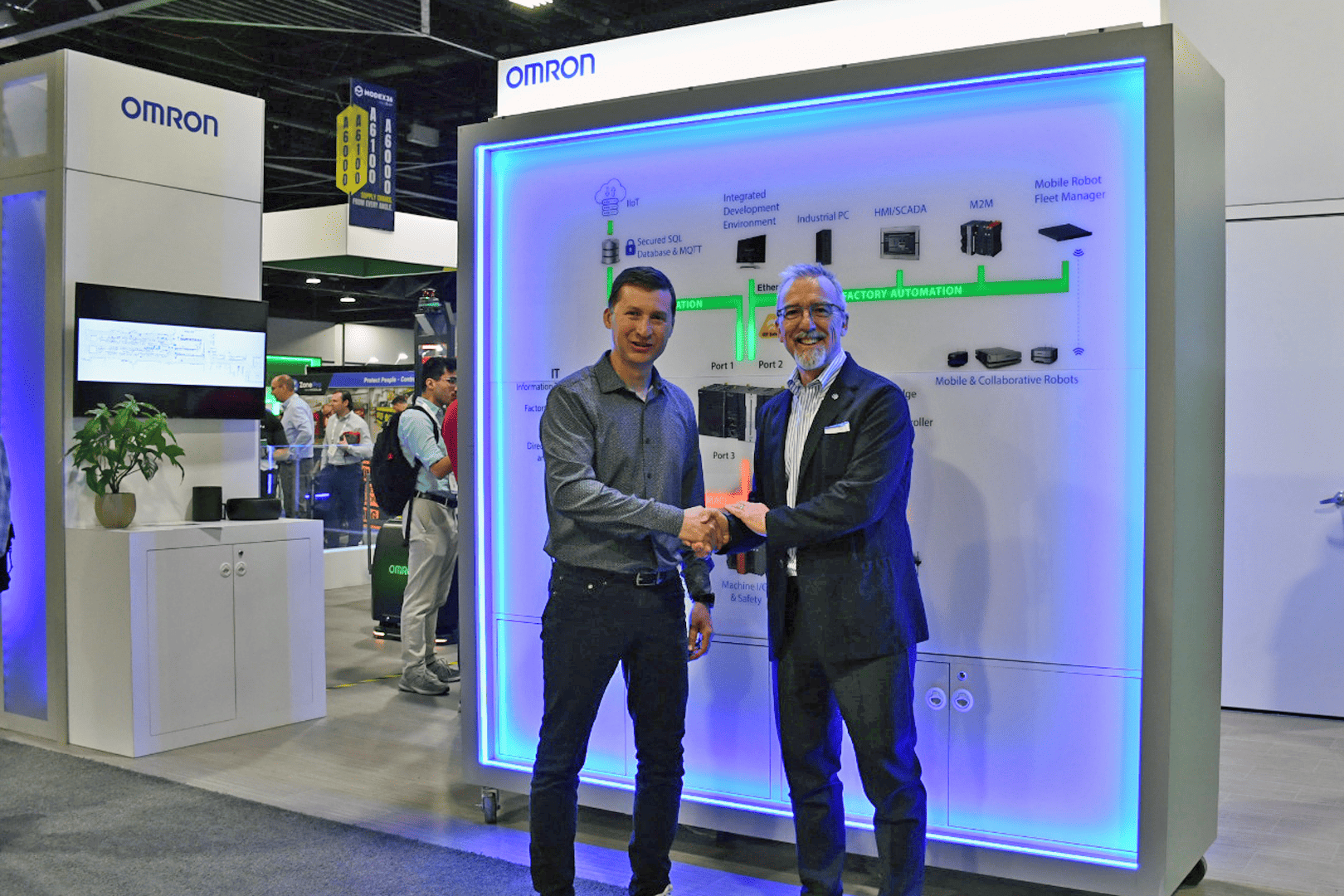
<p>Comau and OMRON Robotics have signed a strategic collaboration agreement aimed at accelerating the adoption and deployment of industrial automation. The companies point to electronics, semiconductor, medical manufacturing and light industrial intralogistics as priority sectors. Their <a href="https://robotics.omron.com/news/omron-comau-partnership/">official announcement</a> presents the move as a combination of Comau’s robotics and application expertise with OMRON’s control, software and automation capabilities; the <a href="https://www.comau.com/wp-content/uploads/2026/05/PR_ENG_Comau_Omron.pdf">joint release published by Comau</a> describes the same direction.</p><h2>What the announcement actually changes</h2><p>For a factory operator, the news is about a route to integration, not a new robot model. Neither company names a new arm, mobile platform, cobot cell or turnkey line. The agreement is intended to make future systems easier to deploy across existing production lines and newer manufacturing environments. That is a meaningful industrial objective, especially in plants where robotics, machine control, vision, safety devices and production software have accumulated from different suppliers.</p><p>The commercial logic is straightforward: Comau brings a large industrial-automation and robotics portfolio, while OMRON brings control technologies, software and a broader automation ecosystem. If the partnership produces a working offer, a manufacturer could eventually have fewer integration boundaries to manage. That is an expectation inferred from the stated scope, however, not a result reported from a named customer site.</p><h2>The measurable claims are still to come</h2><p>The announcement uses terms such as flexible, scalable, reliable and safe, but it does not publish the measurements needed to compare a production cell with an incumbent solution. There is no robot model or payload, no reach or cycle-time figure, no end-effector specification and no stated machine-tending, inspection or material-handling sequence. It also gives no uptime, first-pass-yield, changeover-time, intervention-rate or maintenance result.</p><p>That absence matters because “easy to deploy” can mean very different things on a real line. A cell may be quick to configure yet slow to validate. A control stack may connect devices cleanly while still requiring custom logic for recipes, traceability or fault recovery. A collaborative or mobile subsystem may share space with people only after its speed, stopping distance, loads, tooling and operating modes have been assessed for that particular layout. None of those boundaries can be inferred from a partnership announcement.</p><h2>Safety is an intention, not evidence yet</h2><p>Both companies frame the collaboration around reliable, safe and scalable automation. That is a stated design goal, not proof of a safety performance level. The release does not identify a certified system, a completed risk assessment, a protective-device layout, a validated operating mode or a measured stop-time result. It does not say which future joint solution will be collaborative, guarded, mobile or fixed, so there is no honest basis for assigning one common safety profile.</p><p>For deployment teams, the practical consequence is restraint. A future proposal should be reviewed at cell level, with the robot, gripper, workpiece, fixtures, access points, restart behavior and maintenance tasks all inside the assessment boundary. Commissioning and recovery deserve the same attention as automatic production: the highest-risk moments are often the ones in which a technician is teaching, clearing a fault or changing a tool. This is a deployment principle, not a claim that the announced partnership has already solved it.</p><h2>What would make the partnership operationally credible</h2><p>The next useful evidence would be a named application with a defined load, takt and layout. A credible customer deployment would report the baseline and the result: cycle time under the stated motion pattern, availability over a stated period, changeover time, unplanned interventions, quality yield and the conditions under which those numbers were collected. It would also identify the controller and robot versions, the end effector, the interface to upstream and downstream equipment, and the safeguards used around people.</p><p>That level of detail would let manufacturers separate integration benefit from marketing language. It would show whether the combined stack reduces engineering effort, improves recovery after faults or simply packages familiar components under one commercial relationship. For electronics and medical production, validation, traceability and recipe control may matter as much as arm speed. For intralogistics, traffic behavior, load stability, handoff points and recovery from blocked routes may matter more than a headline throughput figure.</p><h2>Bottom line</h2><p>Comau and OMRON have announced a credible industrial partnership with a clear target: more connected automation for sectors that need flexible deployment. The news supports that roadmap claim. It does not yet support a claim that a joint robot cell is available, safer than an existing design, faster to commission or proven in production.</p><p>Manufacturers should therefore treat this as a signal to watch, not a purchasing specification. The partnership will become materially useful when it produces a named system, a real deployment and measurements that include both productivity and safety boundaries. Until then, the most accurate reading is also the most useful one: the companies have announced intent and complementary capabilities, while the evidence required for a professional deployment decision remains outstanding.</p><section class="media-fleet-sources"><h2>Official sources</h2><ul><li><a href="https://robotics.omron.com/news/omron-comau-partnership/">Official source: robotics.omron.com</a></li><li><a href="https://www.comau.com/wp-content/uploads/2026/05/PR_ENG_Comau_Omron.pdf">Official source: comau.com</a></li></ul></section><aside class="media-fleet-related"><h2>Related reading</h2><ul><li><a href="https://rentbuyrobot.com/article/omron-ol-450s-mast-options-amr-deployment">Omron Ol 450s Mast Options Amr Deployment</a></li><li><a href="https://rentbuyrobot.com/article/omron-ld-150-ld-300-amrs-factory-transport-safety">Omron Ld 150 Ld 300 Amrs Factory Transport Safety</a></li></ul></aside>
PrototypeReport
Comau–OMRON Partnership: What Manufacturers Can Measure Next
The May 2026 agreement targets flexible industrial automation, but names no robot, cell or deployment result. Here is what the announcement supports—and what buyers still need to verify.