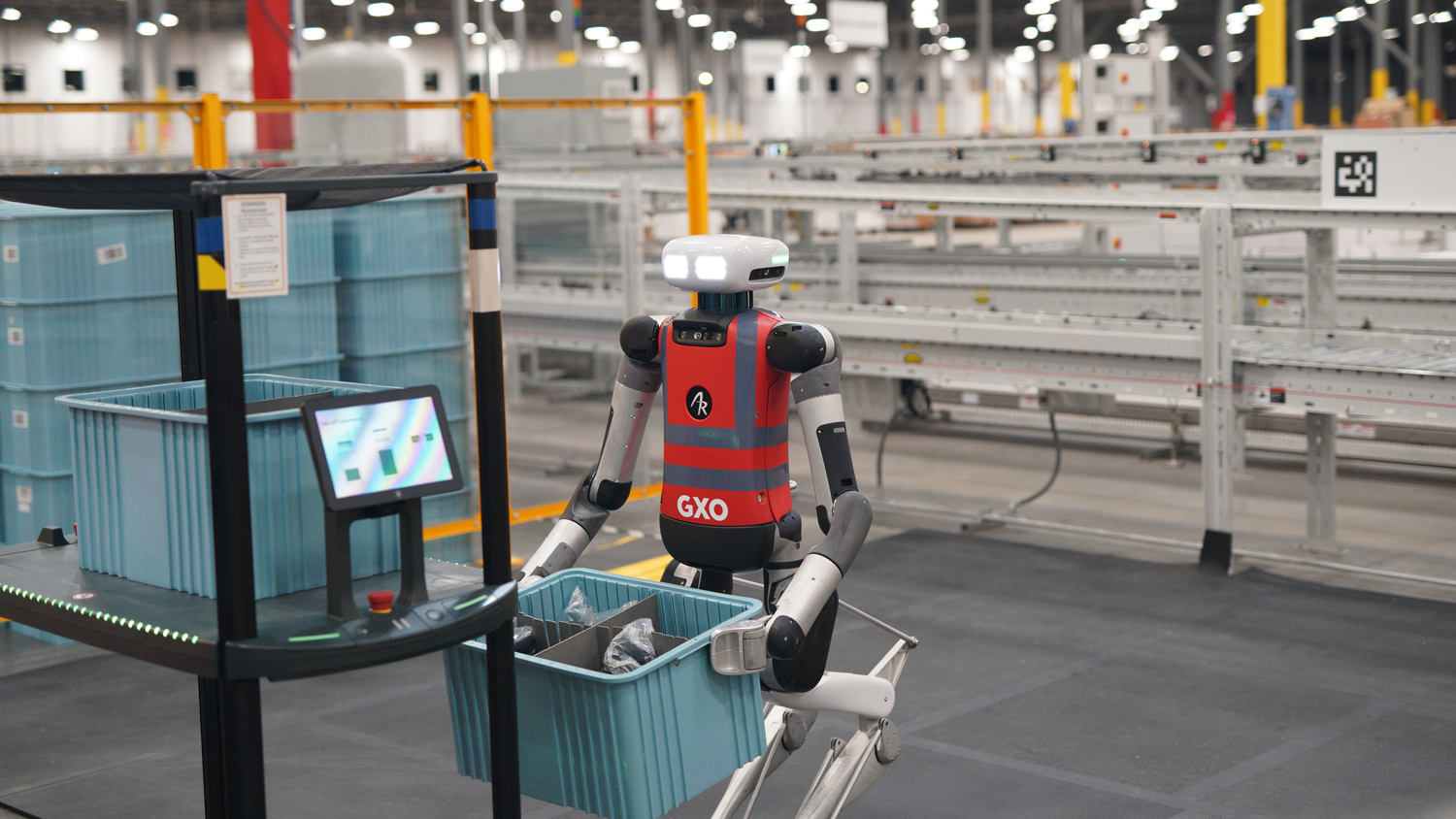
<p>Agility Robotics says Toyota Motor Manufacturing Canada (TMMC) has signed a commercial Robots-as-a-Service agreement for its Digit humanoid robot. The agreement follows what Agility describes as a successful pilot and moves the project beyond a laboratory demonstration. It does not, however, amount to published evidence that Digit is already operating at full production scale across Toyota’s facilities.</p><p>According to the <a href="https://www.agilityrobotics.com/content/agility-robotics-announces-commercial-agreement-with-toyota-motor-manufacturing-canada">official announcement</a>, TMMC plans to deploy Digit in manufacturing, supply-chain and logistics operations at its Canadian facilities. TMMC operates vehicle assembly plants in Cambridge and Woodstock, Ontario. The announcement says the companies will continue assessing use cases for repetitive and physically taxing work, with the stated aim of reducing strain on employees and allowing them to focus on higher-value activities.</p><h2>What the pilot-to-contract step proves</h2><p>The strongest evidence in the announcement is commercial rather than quantitative: a named automotive manufacturer completed a pilot, evaluated robots and then signed an agreement to continue the work. That is materially different from a concept video or a forward-looking claim that a humanoid could eventually work in a factory.</p><p>At the same time, the public information remains narrow. Agility does not disclose the number of Digit robots involved, the pilot duration, the exact task sequence, cycle times, intervention rate, uptime, injury-prevention data or the timetable for the next deployment phase. It also does not identify a specific production line or state whether the planned work will be continuous, seasonal or limited to selected logistics processes. The commercial agreement therefore confirms a transition from evaluation to planned deployment, not a complete performance record for Toyota’s operations.</p><h2>Digit’s stated capabilities and their limits</h2><p>Agility presents Digit as a general-purpose humanoid designed for spaces where people already work. Its <a href="https://www.agilityrobotics.com/solutions">current solution page</a> lists a 35-pound carrying capacity, a four-hour battery life, interchangeable end effectors and the ability to work continuous shifts. Those figures are manufacturer specifications and product claims; the Toyota announcement does not say which configuration was used during the pilot or whether every listed capability was exercised there.</p><p>The human-shaped design is intended to reduce the need for major facility changes. In principle, a bipedal robot can move through existing aisles and interact with equipment built around human workers. In practice, that advantage depends on the task: payload geometry, grasp reliability, floor conditions, pedestrian traffic, charging arrangements and safe recovery from faults all affect whether a humanoid is useful outside a controlled demonstration.</p><h2>Evidence from a separate commercial deployment</h2><p>Agility has published a more specific operational result from another customer site. In its report on a <a href="https://www.agilityrobotics.com/content/digit-moves-over-100k-totes">GXO commercial deployment</a>, the company says Digit moved more than 100,000 totes at a Flowery Branch facility. Agility describes tasks that included moving items on and off an autonomous mobile robot to a conveyor and stacking totes in another floor location. It also identifies dynamic balancing and vision accuracy as capabilities hardened through repeated operation.</p><p>That GXO milestone is useful context, but it should not be presented as Toyota test data. The official image accompanying this article comes from Agility’s GXO deployment report and shows Digit handling a tote in a live logistics environment; it is illustrative of the robot’s demonstrated commercial work, not proof that the same workflow has already been completed at TMMC.</p><h2>Safety is part of the deployment claim</h2><p>Agility says the Toyota project will explore tasks that can be physically taxing for employees and describes its next-generation Digit as intended to work cooperatively around people. The company’s solution page says it worked with industry experts on safe cooperative behaviours. These statements establish the direction of the safety work, but they do not provide a public risk assessment, incident record, certification result or site-specific operating procedure for TMMC.</p><p>That distinction matters because a factory deployment has to manage more than the robot’s nominal ability to walk and carry. Safe operation also requires defined exclusion and interaction zones, emergency-stop access, fault handling, maintenance procedures, training and a clear allocation of responsibility between the robot supplier and the plant operator. None of those details is included in the public commercial announcement, so they should not be inferred from the existence of the contract.</p><h2>A real deployment signal, not a universal humanoid verdict</h2><p>Agility’s agreement with Toyota Canada is a meaningful signal for humanoid robotics: a pilot has produced a commercial commitment in an automotive manufacturing environment, and the intended uses are tied to ordinary industrial work rather than a staged stunt. The GXO result provides additional evidence that Digit has operated through high-volume logistics tasks.</p><p>The boundaries are equally important. Toyota’s next phase is described as planned deployment and continued use-case assessment. Until the companies publish task-level results from TMMC, readers should treat the announcement as evidence of customer adoption and ongoing validation—not as proof that Digit can replace a broad class of factory automation or operate unattended across an entire vehicle plant.</p><section class="media-fleet-sources"><h2>Official sources</h2><ul><li><a href="https://www.agilityrobotics.com/content/agility-robotics-announces-commercial-agreement-with-toyota-motor-manufacturing-canada">Official source: agilityrobotics.com</a></li><li><a href="https://www.agilityrobotics.com/solutions">Official source: agilityrobotics.com</a></li><li><a href="https://www.agilityrobotics.com/content/digit-moves-over-100k-totes">Official source: agilityrobotics.com</a></li></ul></section><aside class="media-fleet-related"><h2>Related reading</h2><ul><li><a href="https://rentbuyrobot.com/article/nvidia-sim-to-real-field-robot-validation">Nvidia Sim To Real Field Robot Validation</a></li><li><a href="https://rentbuyrobot.com/article/nasa-space-roboticist-challenge-orbital-research">Nasa Space Roboticist Challenge Orbital Research</a></li></ul></aside>
PrototypeReport
Agility’s Digit Moves from Pilot to Toyota Canada Deployment
Agility says a successful Digit pilot has led to a commercial agreement with Toyota Canada, but the announcement does not yet prove a full-scale production rollout.